
From Traditional to Modern: Powering pharmacy operations with Compound Direct

Every pharmacy operates differently. Some have embraced modern, systemised workflows, while others continue to rely more on traditional practices. These choices are often shaped by time, resources, and immediate operational needs. However, these are also the determining factors of how well a pharmacy adapts to change, remains compliant, and supports sustainable growth in the long run.
This blog explores the common operational stages pharmacies go through, helping you assess whether your current setup is truly supporting your operations or simply holding them together. You will also learn how to recognise when it’s time to move beyond temporary fixes and build a truly scalable, fully systemised pharmacy.

Evolution of pharmacy operations
As pharmacies grow, their operations typically evolve through a few operational stages. Some rely on pen and paper to manage daily tasks, others introduce spreadsheets to support reporting and routine workflows, and more advanced setups adopt fully systemised digital solutions. Each stage offers a different level of control and visibility, and understanding where your pharmacy currently sits helps clarify whether your processes are keeping up with operational demands or starting to fall behind.
Manual operations (pen & paper control)
Comfort trap
This stage often serves as a safe starting point, especially for privately owned pharmacies. Manual systems are dependable and provide full control over daily operations by using available manual records such as printed forms, logbooks, and checklists. For a time, this approach met your pharmacy’s needs and provided reassurance.
The familiarity of knowing where things were, how records were kept, and who was responsible all represented stability. However, data still had to be manually re-entered from printed forms to logbooks every time.
That sense of control can feel comforting, but makes it easy to overlook the limits of manual systems. What once worked well quietly becomes a trap of inconsistencies and stalled growth.
Cost of oversight
If the comfort trap applies to your pharmacy, gaps become part of normal operations, resulting in different versions of the truth. Over time, this leads to wasted stock, service disruption, and extra labor spent in correcting mismatches. Here’s a quick look at the risks and how Compound Direct steps in.
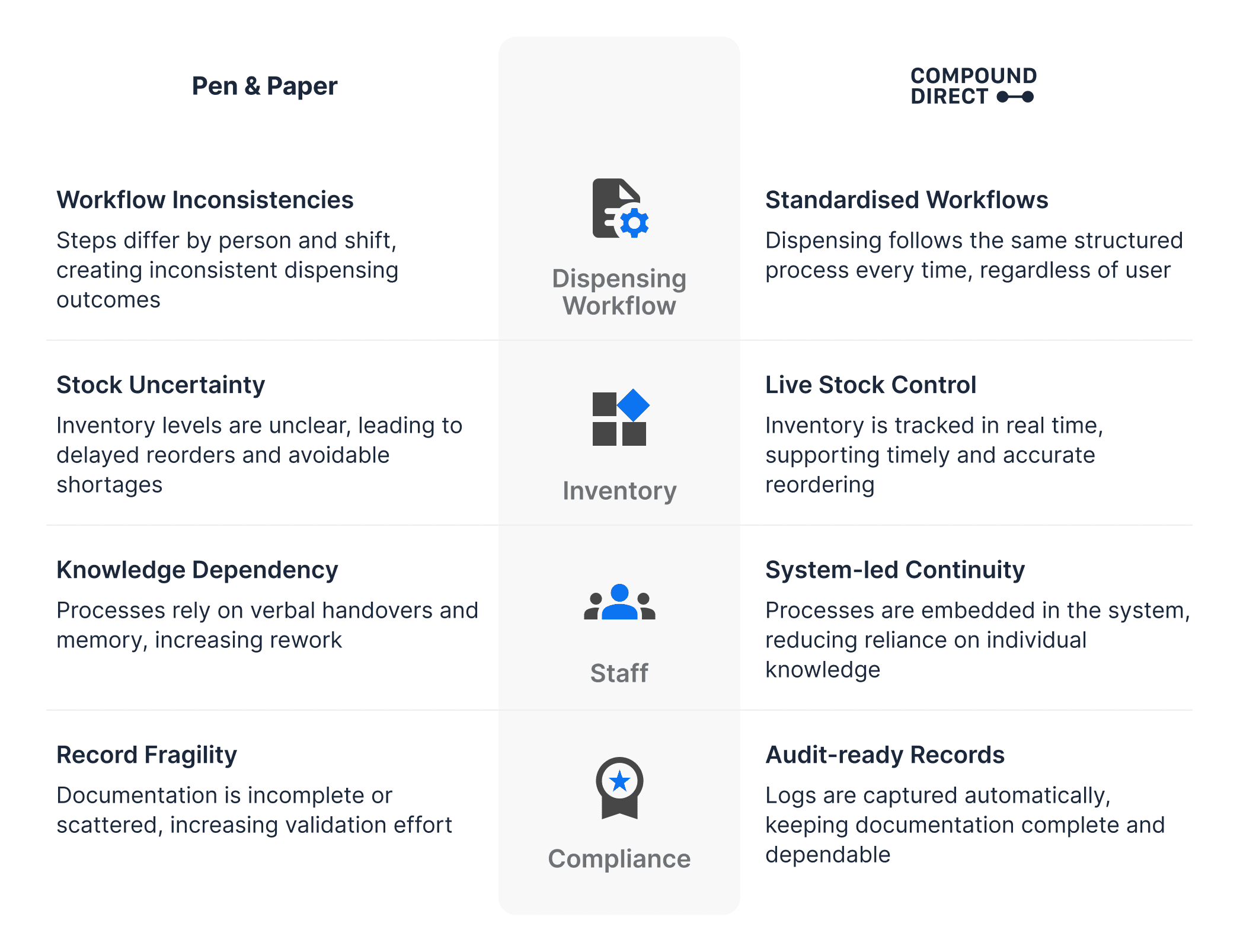
Tip: Check each point that applies, even one is enough to show manual oversight is costing time and resources.
Manual methods can seem economical at first. Small discrepancies might not matter today, but repeated errors pile up, costing more time and effort. For a deeper look at these hidden costs, see: The Hidden Costs of Manual Compounding: A smarter way forward with Compound Direct
In summary, this stage works until volume increases. While pen and paper may create comfort, traceability is what a pharmacy needs for long-term safety.
A system designed to turn oversight into control can help. Compound Direct takes on the heavy lifting by standardising workflows and tracking activity in real-time, so the pharmacy runs smoothly without constant manual checks. To see how Compound Direct standardises workflows in action, have a look at these:
- Order Workflows in Action: Processing in-store and online orders in Compound Direct
- Efficient inventory management: How Compound Direct's stocktaking saves time and money
Spreadsheet-driven operations
Faster, but not safer
Moving to spreadsheets may seem like a major upgrade from manual methods because it centralises information, speeds up calculations, and reduces inconsistencies from paper-based work.
However, the risks remain as it still relies heavily on manual checks. This is because spreadsheets do not actively guard mistakes on their own. In other words, spreadsheets make data faster to access, but not automatically safer.
Spreadsheets are a tool, not a system
This is where a proper system, such as Compound Direct, becomes necessary. It goes beyond data entries, it supports the whole process with structure and control. See the table below on how Compound Direct already accounted for the gaps when spreadsheets show its limits as a people-dependent tool.
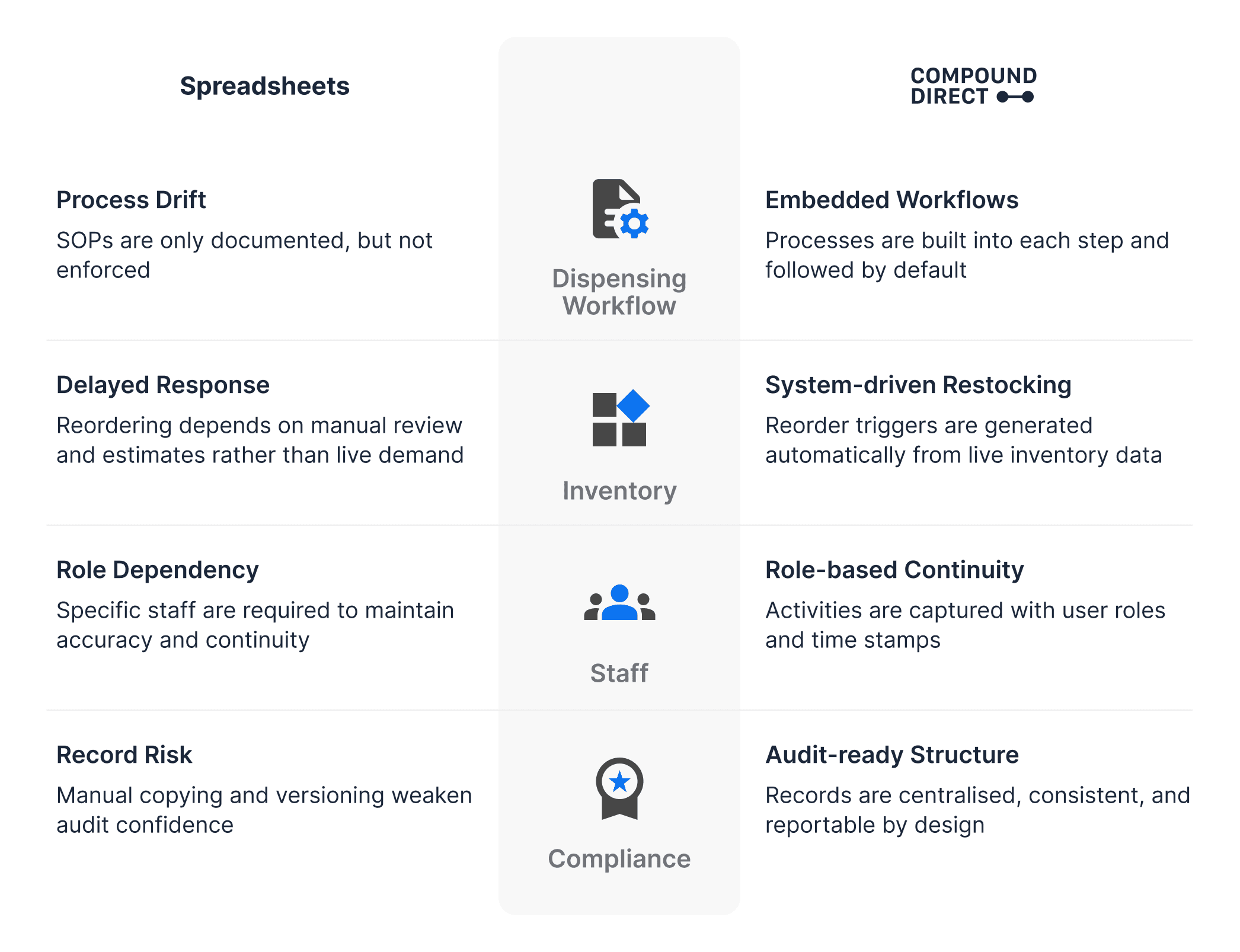
The issue is not that “spreadsheets are bad”, but what it is not designed to do. Neither the spreadsheets nor their formulas will flag whether the implemented processes disrupt a defined workflow.
It is limited to support the operations, but not to enforce, and that’s what keeps it as a tool rather than a system.
The in-between phase creates the most risk
Mixed systems of part paper, part spreadsheets, and part memory are the most dangerous phase due to their lack of consistency. This is not because you’re careless, but because the setup makes it easy for gaps to slip through.
In a 2020 cross-sectional study of Malaysian community pharmacies:
- 77% use electronic health records
- Of those, 92% used electronic payment systems
- Of those, 68% used software for accounting and logistics
These numbers show that most pharmacies already operate in a mixed system where digital workflows exist but are only partially implemented. Every process break demands more effort to check and validate, and reconciliation becomes a job in itself.
The question isn’t whether this setup works; the real question is, does your current setup support your pharmacy’s next phase of growth? Look at each stage of your process and spot where gaps appear, then start replacing manual steps with a system that keeps work accurate and reliable.
Systemised digital operations
What modern solutions actually mean
Systemisation in pharmacy is often misunderstood. For some, it means moving from paper to sheets. For others, it means adding software on top of existing processes.
True systemisation goes beyond the format of the tools you use. It defines how work is performed and completed across the pharmacy with maximum reliability and consistency.
Here is a quick comparison for your easy reference;
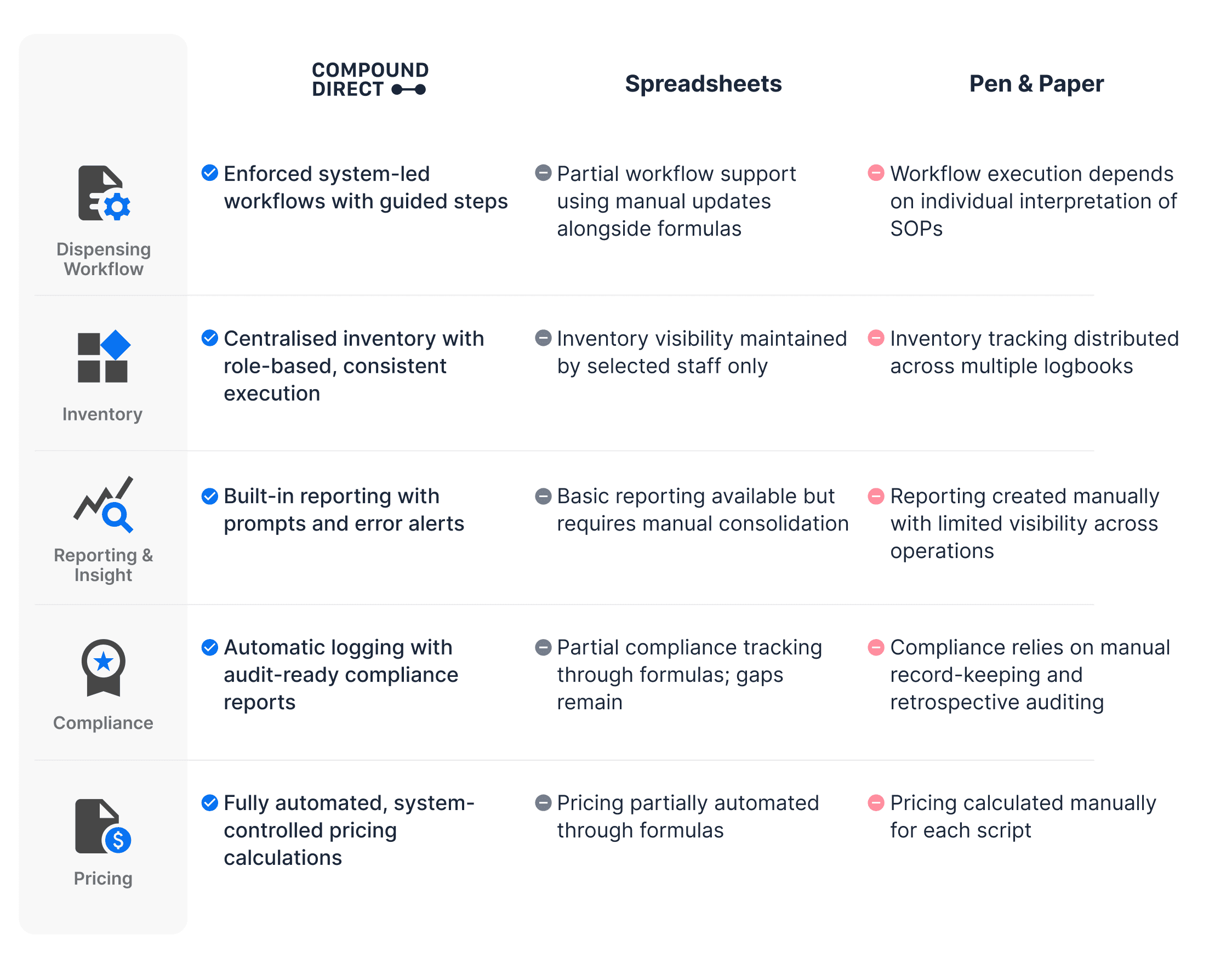
For a practical example of modern systemisation in pharmacy, see how Compound Direct delivers consistent calculations and workflow logic in Behind the formula: What the system calculates for you | Compound Direct.
Software doesn’t replace staff, it protects them
The software drastically reduces the daunting manual tasks from stocktaking to fulfilling orders, so your team can focus on what matters most.
Imagine a system that alerts your team if a step is missed during the compounding process, tracks what’s done, and gives you confidence that gaps are eliminated. Your staff is still doing the work; they are just supported and protected by the system.
Software such as Compound Direct does not replace your staff’s knowledge. It ensures that their expertise is applied consistently where it is needed.
“Our pharmacy is too small for a software”
It is a given that digital costs more than manual labor in the beginning. But as previously discussed, manual methods cost you more in the long run. Think of it this way: software is your insurance against slow, expensive build-up of oversights.
Your pharmacy requires the same core responsibilities to function regardless of size. A better question to ask yourself is: “How many manual steps are you willing to keep paying for as you grow?”
Save yourself from paying the cost in time, rework, and risk by using Compound Direct, which gives you one source of truth and can work with you as your pharmacy grows, not just tools that help you get through the day.
Conclusion
Pharmacies that have shifted from paper and spreadsheets to a systemised solution report fewer errors, faster batch processing, and better staff productivity. Whichever stage you are in, Compound Direct can help you centralise SOPs, automate inventory updates, and make batch tracking seamless, even if you’re only starting to digitise part of your workflow.
If you are ready to build a truly systemised pharmacy, book a demo now.
All names and medical data shown in software screenshots are fictional and for demonstration purposes only. These figures represent fictional persons; any resemblance to real individuals is purely coincidental. Use of existing fictional names is for illustrative purposes and does not imply affiliation or endorsement.