
Salt-to-Base Factors in Compound Direct: Ensuring accurate pharmacy compounding calculations

Salt-to-base correction factors are used in compounding pharmacies when a medication is supplied as a salt form but the prescribed dose refers to the active drug (base or acid). In these situations, pharmacists must account for the weight of the salt so the final preparation delivers the correct amount of the active drug.
This adjustment uses a salt-to-base correction factor, which accounts for the difference between the molecular weight of the salt form and the active drug without the salt.
In this blog, we explain what a salt-to-base correction factor is, how it is calculated, and how Compound Direct simplifies the process. By entering the correction factor at the ingredient batch level, Compound Direct automatically applies it during formulation calculations, helping ensure accurate dosing while reducing manual calculations.
What is a salt-to-base factor?
To understand salt-to-base correction factors, it is important to first understand the difference between the active drug (base or acid) and its salt form, which is often the form supplied for compounding.
- Base (or acid): The active drug molecule responsible for the therapeutic effect (e.g. lidocaine, diclofenac).
- Salt: A form of the drug combined with another substance to improve properties such as solubility, absorption or stability (e.g. lidocaine hydrochloride, diclofenac sodium).
A salt-to-base correction factor is used in compounding to convert the weight of a drug in its salt form into the equivalent amount of active drug (free base or acid), because only the active drug component contributes to the pharmacological effect, while the salt component adds to the total weight. The correction factor adjusts for this difference so the final preparation delivers the intended amount of active ingredient.
Calculating the salt-to-base factor
The salt-to-base factor is calculated by dividing the molecular weight of the salt form by the molecular weight of the base. This ratio indicates how much of the salt is required to provide a given amount of active drug and allows the weighed quantity to be adjusted accordingly.
To gather the molecular weight required for salt-to-base calculations, pharmacopeias such as USP-NF, BP, and Ph. Eur. are the most reliable sources because they provide authoritative molecular weights and defined equivalence between drug salts and base forms. Supporting references include DrugBank, CAS Common Chemistry, and PubChem for molecular weight verification, with supplier Certificates of Analysis (CofA) or Safety Data Sheets (SDS) used only as secondary confirmation.
For example, consider fluoxetine hydrochloride vs fluoxetine.
- Molecular weight of fluoxetine hydrochloride = 345.79
- Molecular weight of fluoxetine base = 309.33
Salt-to-base factor = Molecular weight of salt ÷ Molecular weight of base
= 345.79 ÷ 309.33
≈ 1.12 (This is the value entered in Compound Direct)
This means approximately 1.12 mg of fluoxetine hydrochloride is required to provide 1 mg of fluoxetine base.
Applying the salt-to-base factor in Compound Direct
When working with a salt form of a drug, such as fluoxetine hydrochloride vs fluoxetine, it is important to confirm whether the prescribed dose refers to the salt form or the active base. Clinical references and prescribing information may express the dose as the active drug, even though the supplied ingredient is a salt.
In Compound Direct, the salt-to-base factor can be entered when adding a new ingredient batch. Once entered, the platform automatically applies the salt-to-base factor during calculations to achieve the intended active drug dose
Important Note: When creating new batches of the same ingredient, the salt-to-base factor is carried over by default and can be reviewed or adjusted at the batch level if required.
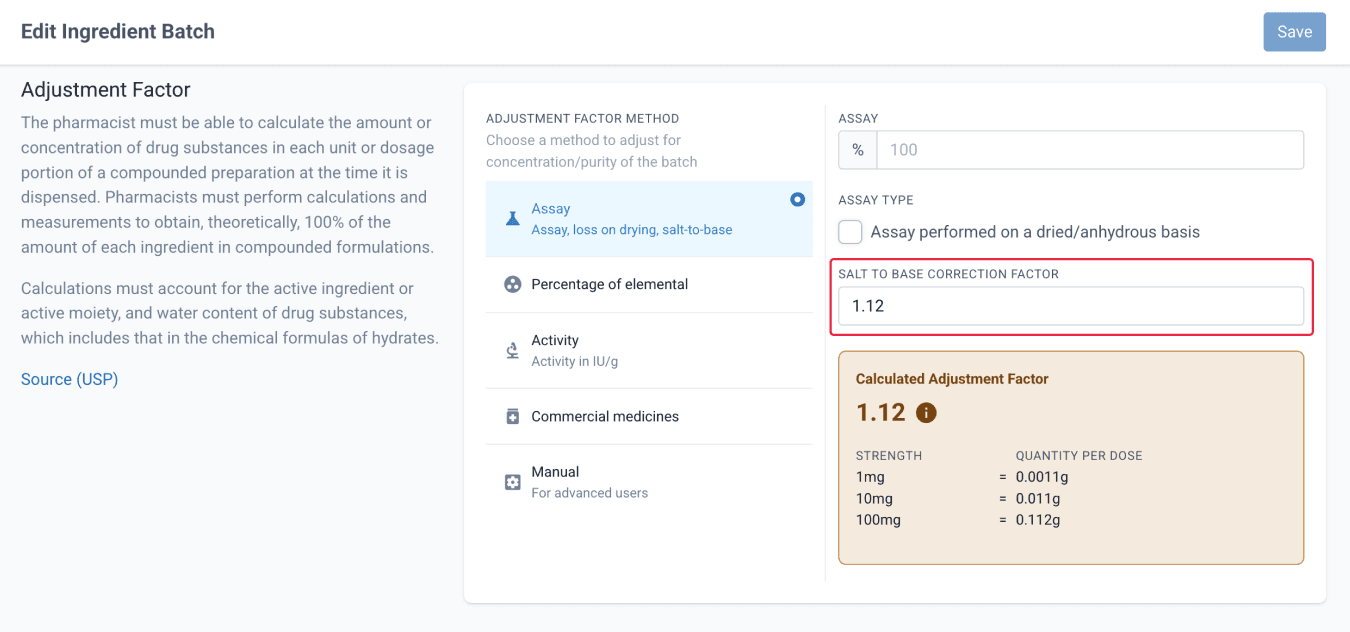
From the ingredients page
When the ingredient is used in a formulation, this factor is applied to the ingredient calculations so the system determines the required quantity of the salt while accounting for the active drug equivalence.
To illustrate how the salt-to-base factor is applied in practice, let’s use a fluoxetine oral suspension as an example. In this formulation, the prescribed strength is expressed as fluoxetine (base), while the ingredient supplied is fluoxetine hydrochloride.
Because the salt-to-base factor has been entered at the ingredient batch level, Compound Direct automatically applies this factor during formulation calculations. This ensures the correct quantity of fluoxetine hydrochloride is used to deliver the intended fluoxetine base dose in the final preparation.
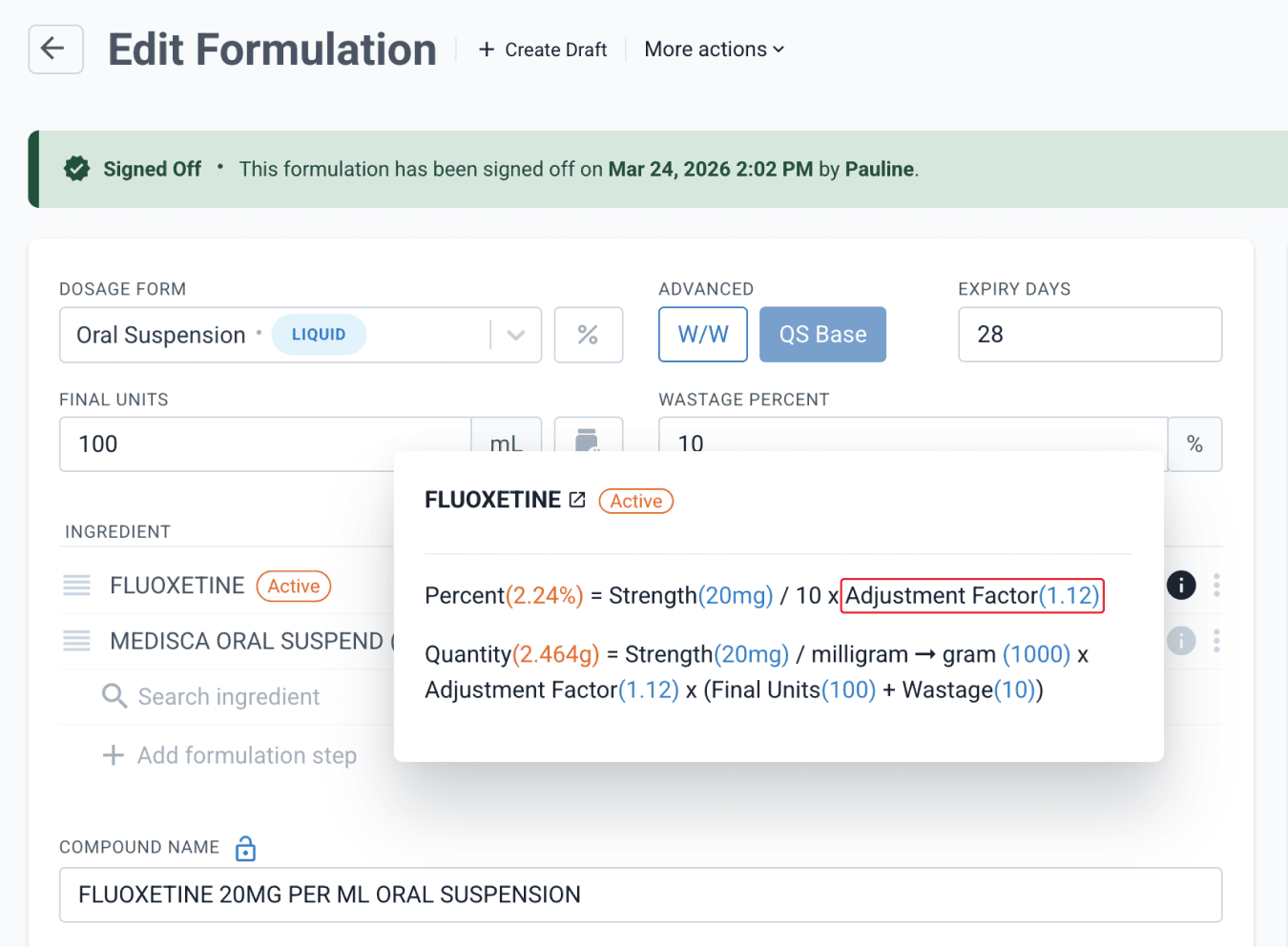
From the formulations page
When entering salt-to-base factors in Compound Direct, it is recommended to verify the accuracy of the information to ensure the correct values are being applied. After making any adjustments (e.g. salt-to-base factor or assay), it is good practice to validate the outcome by reviewing how the ingredient is calculated within a formulation.
By hovering over the ingredient in the formulation view, you can confirm whether the calculated quantity aligns with your expected result based on manual calculations. This provides a quick way to ensure the adjustment has been applied correctly and helps identify any discrepancies early, particularly in cases where calculated values differ from external references.
Ingredients with multiple salt forms
In some cases, the same active ingredient may be available in multiple salt forms (e.g. hydrochloride, sodium, or dihydrate), each with a different molecular weight and corresponding salt-to-base factor. To reduce the risk of confusion or incorrect application of adjustments, it is generally recommended to set up each salt form as a separate ingredient rather than managing them under different batches of the same ingredient.
This approach provides clearer separation between salt forms, ensures the correct salt-to-base factor is consistently applied, and helps minimise the risk of dosing errors, particularly when multiple users or formulations are involved.
General considerations for applying salt-to-base conversions
Salt-to-base adjustments should be applied with a clear understanding of how the ingredient strength is defined and how it is used within the formulation. Not all preparations require a salt-to-base conversion, and whether it is applied is often a clinical or formulation decision based on the context of use. Rather than treating this as a fixed rule, it is important to ensure consistency in how an ingredient is handled across formulations to avoid unintended variation in dosing.
Once a salt-to-base factor is applied within the system, it is applied consistently and cannot be selectively turned on or off for different scenarios of the same ingredient. For this reason, careful consideration should be given during setup, along with clear documentation in formulations where needed. The system provides the tools to apply the adjustment, but determining whether it should be used remains a professional and clinical decision based on the context of the preparation. This consistency is important, as applying the factor inconsistently across formulations may lead to unintended underdosing or overdosing if the adjustment is not clearly recognised.
In some preparations, the salt form itself is intended and should be used as-is, without applying a salt-to-base adjustment. For example, certain injectable products, such as lidocaine hydrochloride injection, are formulated and expressed in terms of the salt form, where the labelled strength already reflects the intended clinical use. In these cases, applying a salt-to-base conversion may not be appropriate, and the decision should be based on how the strength is defined in the formulation or prescribing context.
Salt-to-base for commercial preparations
Always confirm whether a commercial product is labelled as the base or the salt form. Many commercial products are already standardised to the base equivalent, meaning the salt-to-base adjustment has been accounted for during manufacturing and no further adjustment is required. However, some products may still be labelled as the salt, so applying a conversion may be necessary depending on how the formulation strength is defined.
It is important to verify this through reliable references such as pharmacopeias, product information, or ingredient breakdowns, as assumptions can lead to double adjustment or incorrect dosing. In some cases, the product name may reference the base while the ingredient composition reflects a salt that has already been adjusted, so checking both labelling and composition is essential before applying any additional conversion.
Salt-to-base for triturations and dilutions
When preparing triturations or dilutions, the salt-to-base adjustment should only be applied once within the workflow. If the adjustment has already been accounted for at the raw ingredient level, it should not be applied again at the dilution stage, as this will result in double adjustment and an incorrect final strength.
Before applying any adjustment at the dilution level, consider whether the base equivalent has already been established in the ingredient setup. Maintaining a consistent approach and documenting how the ingredient is treated will help prevent confusion, particularly in shared or repeated formulations where multiple users may be involved.
Common mistake: Applying the salt-to-base factor more than once within the workflow, such as at both the ingredient and dilution stages, which can lead to incorrect final strength.
FAQs
How do I know when I need to use a salt-to-base factor?
This depends on how the strength is defined in the formulation or prescribing context. A salt-to-base factor is typically used when the ingredient is supplied as a salt, but the prescribed dose refers to the active drug (base or acid). However, not all preparations require this adjustment. In some cases, such as certain commercial or injectable products, the salt form itself is intended and should be used as-is. It is important to confirm how the strength is prescribed and apply the adjustment consistently where appropriate.
Can I choose when to apply the salt-to-base factor and when not to?
No. Once a salt-to-base factor is applied to an ingredient batch in Compound Direct, it is applied consistently wherever that batch is used and cannot be selectively turned on or off. Whether the adjustment should be applied is a clinical or formulation decision, so it is important to decide this during setup and maintain consistency across formulations.
When I add a salt-to-base factor, the formulation page doesn’t show the expected value. Why?
After entering a salt-to-base factor, it is recommended to verify the result within a formulation. You can hover over the ingredient to review how the quantity is being calculated and confirm whether it matches your expected value based on manual calculations. If there is a discrepancy, it may be due to incorrect input values (e.g. molecular weight, assay, or factor) or differences in how the strength is defined.
Do I need to apply the salt-to-base factor again for aliquots or dilutions?
No. The salt-to-base factor should only be applied once within the workflow. If it has already been applied at the raw ingredient level, it should not be applied again during aliquots or dilutions, as this will result in double adjustment and an incorrect final strength.
Summary
Salt-to-base correction factors play an important role in compounding when a medication is supplied as a salt form but prescribed as the active drug. By accounting for the difference in molecular weight between the salt and the active component, pharmacists can ensure accurate dosing in the final preparation. Compound Direct streamlines this process by allowing the salt-to-base factor to be applied at the ingredient batch level, where it is then automatically incorporated into formulation calculations to determine the correct quantity of salt required.
All names and medical data shown in software screenshots are fictional and for demonstration purposes only. These figures represent fictional persons; any resemblance to real individuals is purely coincidental. Use of existing fictional names is for illustrative purposes and does not imply affiliation or endorsement.