
The Price is Right: Intelligent pricing with Compound Direct

Pricing compounded medicines is never straightforward. Costs go far beyond ingredients and labour, with factors such as supply changes, overheads, and market conditions quickly affecting margins. Compound Direct simplifies the process by making costs transparent and pricing flexible. With real-time calculations, configurable pricing structures, and the ability to set formulation-specific prices, you can price compounds logically, respond to cost changes, and maintain consistent pricing across your pharmacy.
This guide walks you through how pricing works in Compound Direct, from ingredient and device costs to final compound prices, so you can make confident and informed decisions.
Common questions around pricing
Q: How does your lab structure its pricing?
It’s a question that not all pharmacies can confidently answer. Often, pricing is shaped by a combination of less tangible factors such as location, competition, intuition, and patient demographics.
Q: What is the cost of compounding a medicine?
There are many costs involved in producing a medication. Some are obvious, while others are less immediately apparent. When we think about the cost to produce 100 capsules, we usually focus on the most visible expenses, such as:
- The ingredient(s)
- Devices and consumables
- Labour
But these are not the only costs involved. Other ongoing expenses are often overlooked, including:
- Lease
- Equipment purchase and maintenance
- Insurance or medical screening
- Training and education
- Software
- Communication costs (SMS, notifications, etc.)
- Wastage
Depending on how your lab is set up, these costs can vary significantly and may be impacting your profitability. While compounding provides an essential service to patients, it cannot be sustained if it is not profitable.
Q: How much should a compound cost?
This can be an uncomfortable question to answer. Prices may feel too low, too high, or simply difficult to justify. Often, the challenge is knowing where to begin.
The price of a compounded medication should reflect all the costs required to produce and dispense it safely. This includes both direct and indirect expenses, as well as the complexity of the preparation and the requirements for appropriate packaging and patient use. When viewed this way, pricing becomes clearer and more defensible.
Ingredient pricing
Compound Direct allows you to change how you price your individual ingredients. These are set at the ingredient level, not batch level. You can set a different calculation to different ingredients. By default it uses the selected options in the image below.
In Compound Direct, ingredients can be priced using three pricing functions:
- List cost (per unit or gram)
A fixed cost set by the pharmacy. This may be higher or lower than the actual batch cost and is useful when you want consistent pricing regardless of purchase variations. - Average price
Calculates the average cost per unit or gram across all available batches of the ingredient. - Next available batch
Prices the ingredient based on the cost of the next batch available in the system.
Ideal batch cost
The ideal batch cost is calculated by selecting one of the options shown next to number 4. You can select to use the batch with the least quantity remaining, the next batch to expire, or the newest batch that you’ve entered. This is set per ingredient and can be different for each ingredient.
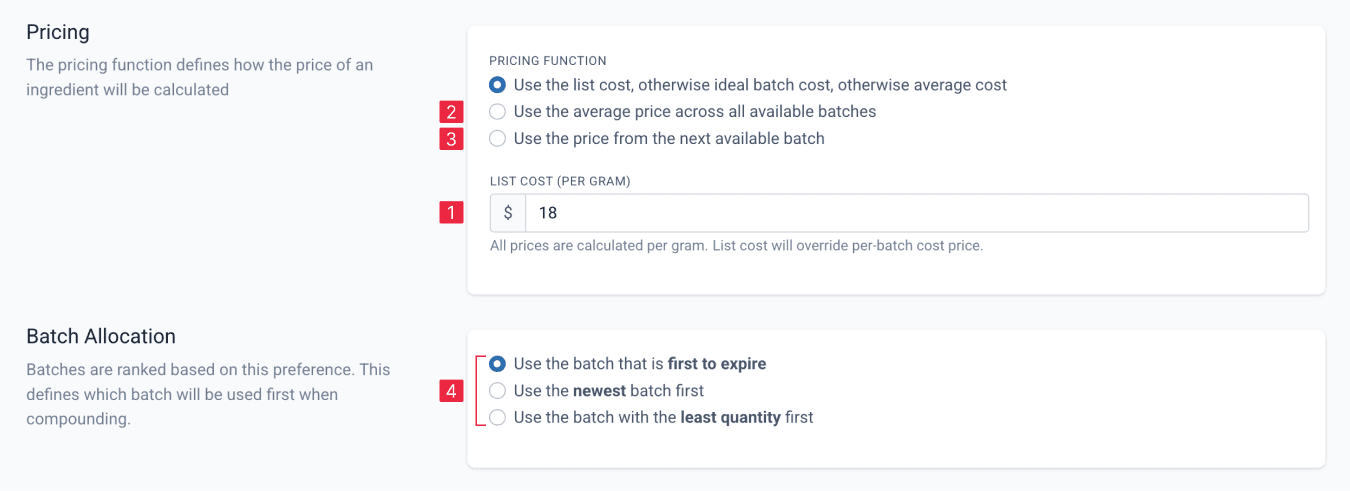
From the edit ingredient page
Important Note: Ensure that the correct pricing function is selected, as this determines the ingredient cost used in compound pricing and formulation pricing. A common mistake is leaving the pricing function set to List Cost, and this setting is often not updated after ingredient batches are added, resulting in costs being calculated from the list cost instead of the intended average batch price or next available batch price.
List cost override
Per the above, selecting List Cost will override the per-batch cost price. You may choose to enter a different List Cost (per gram), which will apply as a fixed price per gram for that ingredient. There are scenarios where this may be useful, for example, if an ingredient is not available in smaller quantities and is likely to expire with some wastage. In this case, you may wish to estimate the expected usable quantity over the life of the product and divide the total purchase cost by that amount to determine an effective per-gram cost.
If a value is entered in this field, a warning will be displayed on the ingredient page. The average batch cost will also be shown for comparison.
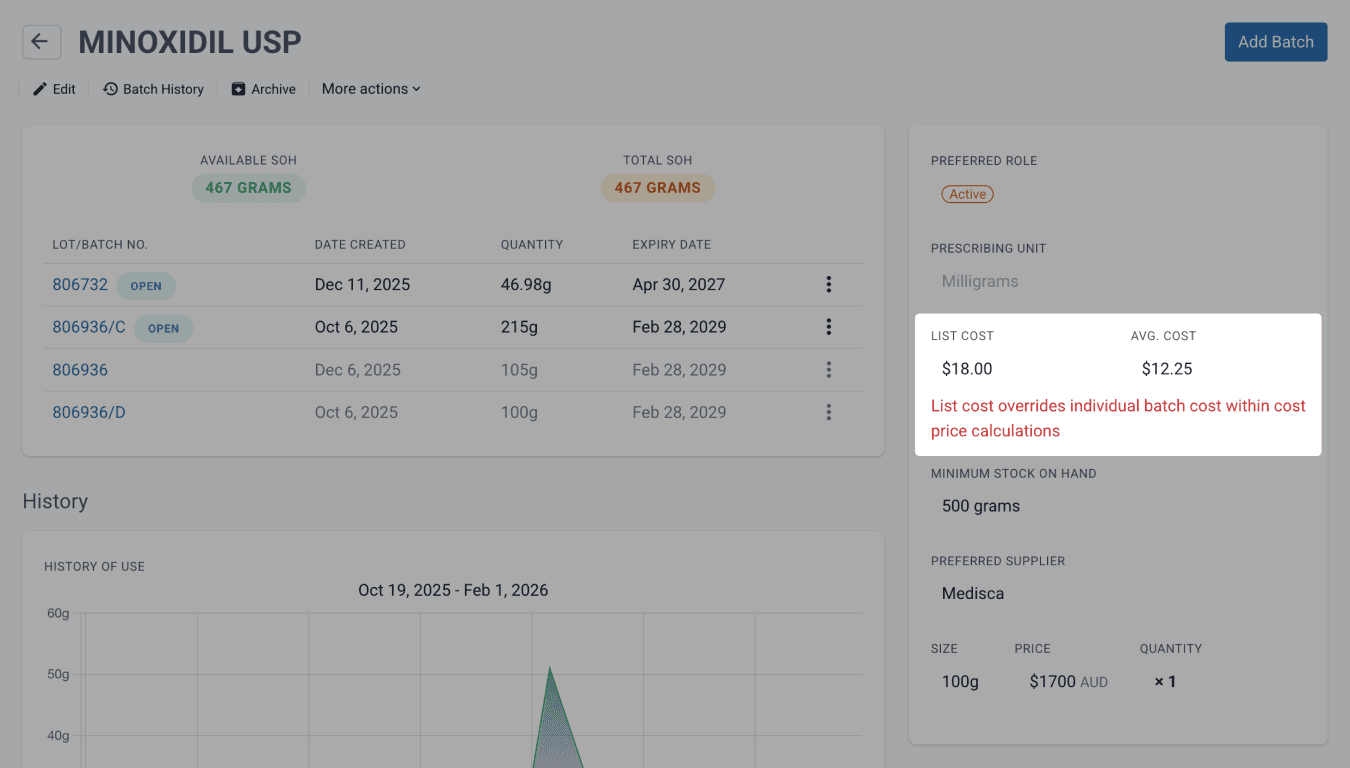
From the ingredient page
Compound pricing
Compound pricing refers to a structured formula used to calculate the final price of a compounded medication based on defined cost inputs. These pricing structures appear as the default pricing option when creating a draft order or when preparing formulation prices (set prices), ensuring consistent pricing across both drafting and formulation setup stages. Pricing structures can be applied across all compounds or restricted to selected dosage forms, providing transparency and alignment with your pharmacy’s compounding workflows.

From the settings page
Elements of a compound pricing structure
A pricing structure in Compound Direct has seven key elements:
- Name – Provide a clear and descriptive name to distinguish the structure and indicate when it should be applied.
- Labour Cost – Set the labour cost, which can be the highest paid staff member involved or an average across all staff, depending on your workflow. Labour duration is defined in the dosage form settings.
- Labour Cost Multiplier – Adjusts the labour cost based on the complexity or time required for the formulation.
- Device Cost Multiplier – Adds costs for any devices used in the formula; requires devices to be activated in your package.
- Base Cost per Script – A fixed fee applied to all formulations under the structure. Often used to account for devices if they aren’t included in the formula, sometimes called a lab fee.
- Ingredient Cost Multiplier – Multiplies the cost of all ingredients by a specified value, useful when ingredients may expire or require additional monitoring, storage, or handling.
- Limits per Range or Dosage Form – Restricts the pricing structure to specific ranges of final units or particular dosage forms, ensuring the structure is applied only where appropriate.
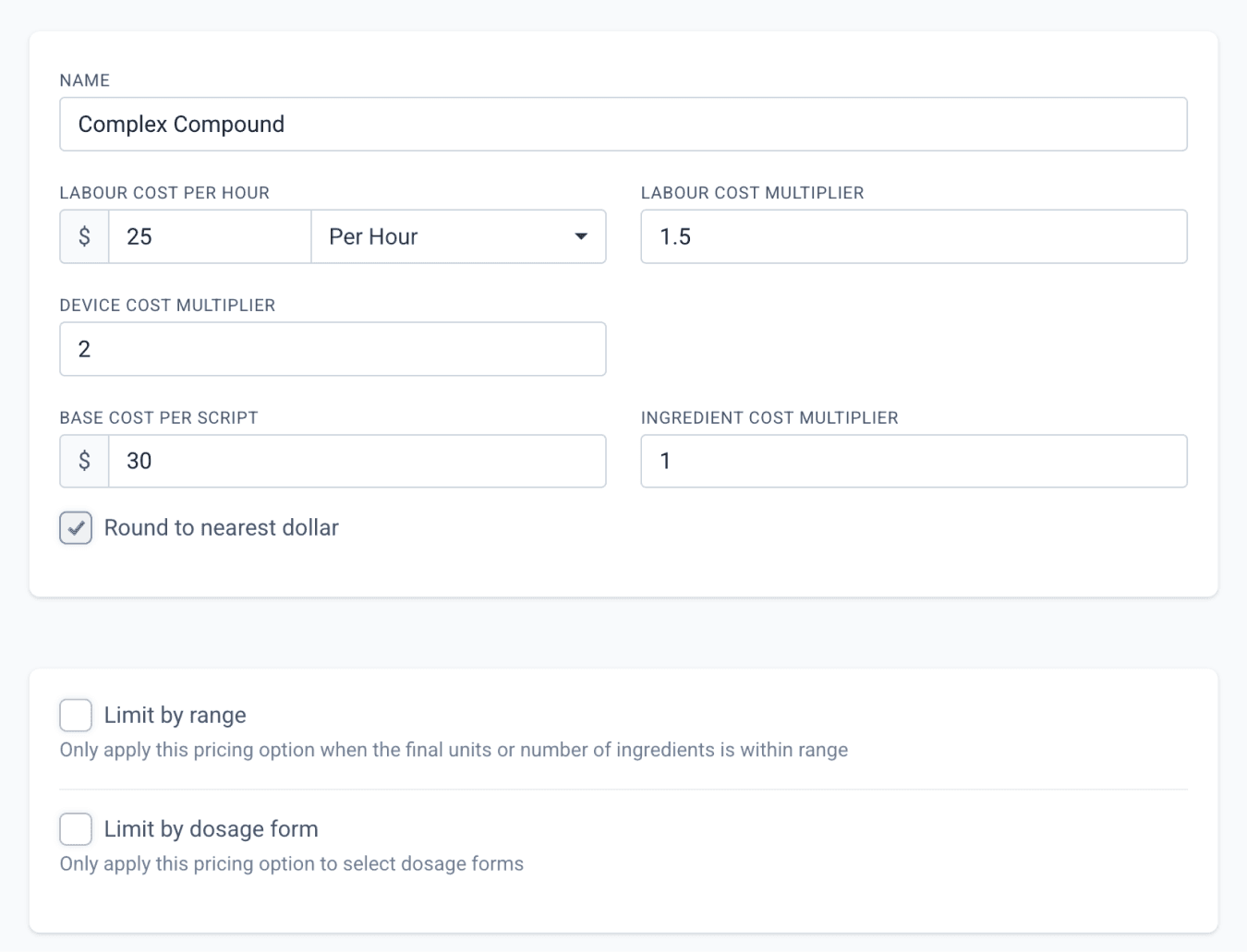
From the compound pricing page
Considerations for good pricing structures
When planning how you will price your compounds, it’s important to think ahead and establish logical pricing structures that can be applied across a wide range of formulations.
Below is an example of three broad pricing structures designed to account for different levels of formulation complexity.
Note: In this model, you can either create all of the listed dosage forms and restrict each pricing structure to a specific dosage form, or allow multiple pricing structures per dosage form and select the appropriate one during the drafting process based on the formulation itself, rather than creating multiple dosage forms.
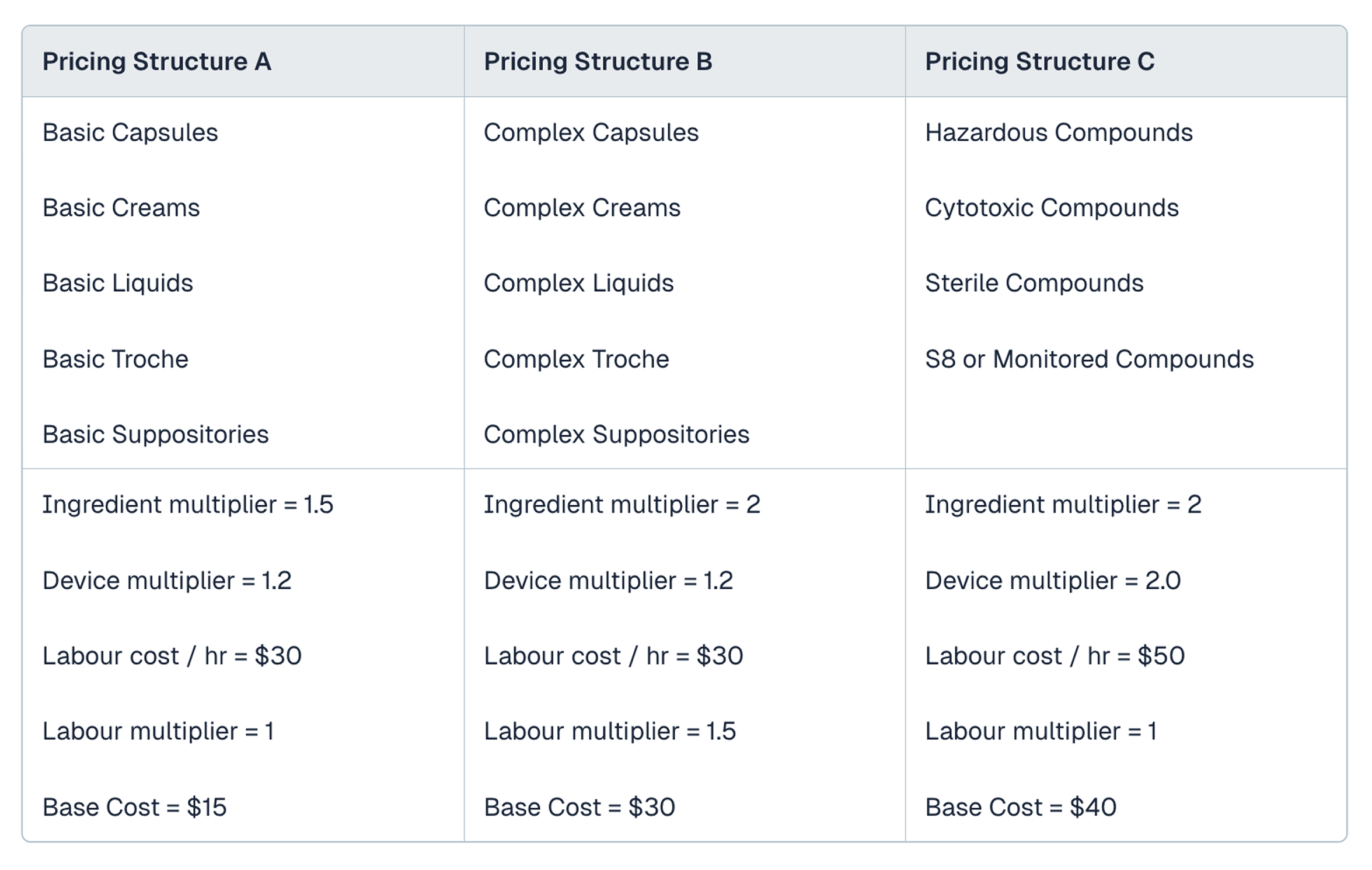
Formulation pricing
Formulation pricing lets you move beyond one size fits all pricing and take control where it matters most. You can set prices directly on a formulation by quantity, name them for different use cases such as in pharmacy, B2B, or promotions, and use existing pricing structures as a reference rather than a rule.
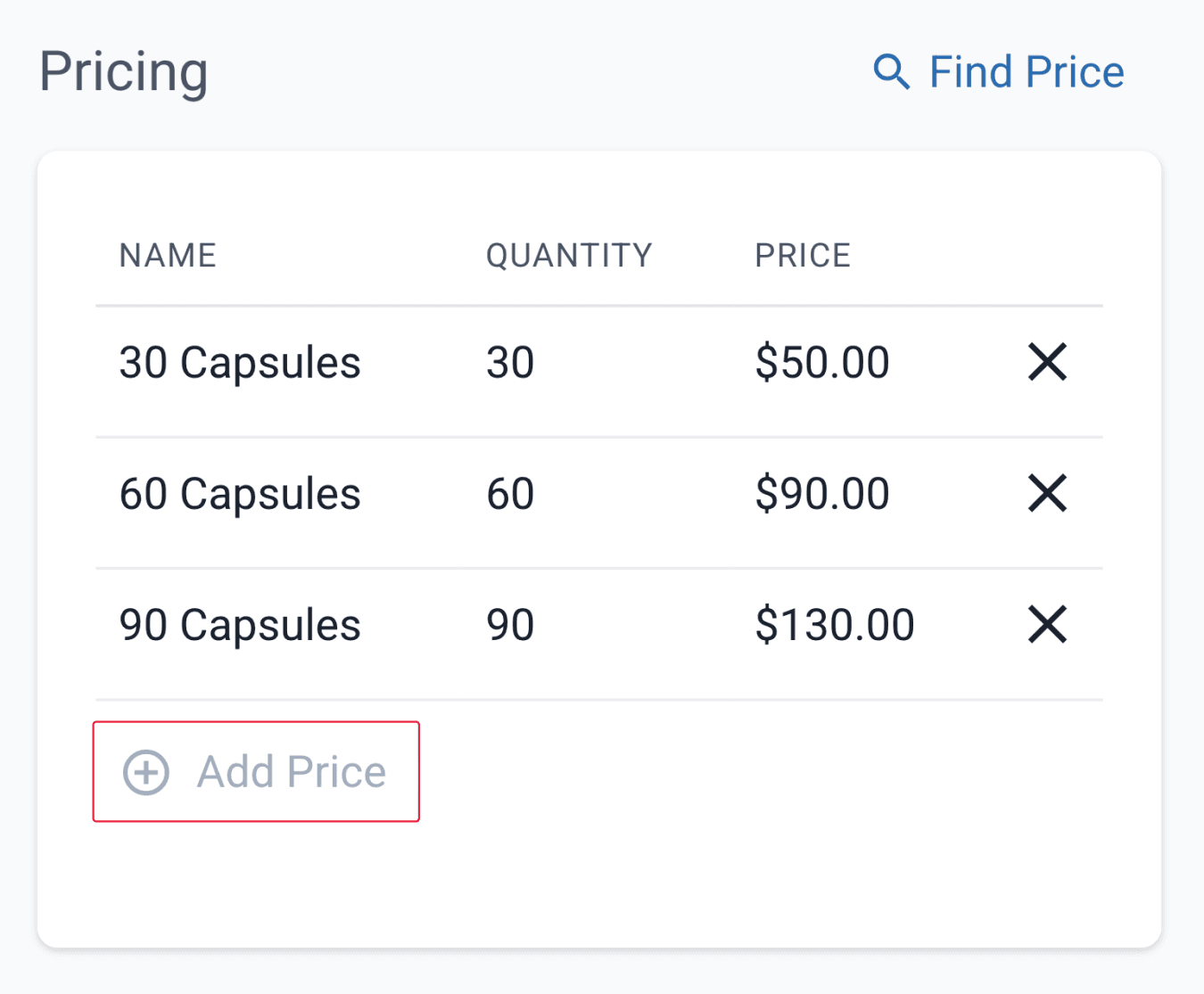
From the formulations page
You can create multiple formulation pricing options and refine them intelligently. Adjust prices up or down with percentage changes, apply rounding rules that match how your pharmacy prices to patients, and explore cost, current, and recommended prices through trend visualisation.
By switching between linear and volume based views and adjusting price points directly on the graph, formulation pricing becomes a practical tool for testing, validating, and maintaining fair and defensible prices without losing sight of margins as costs change.
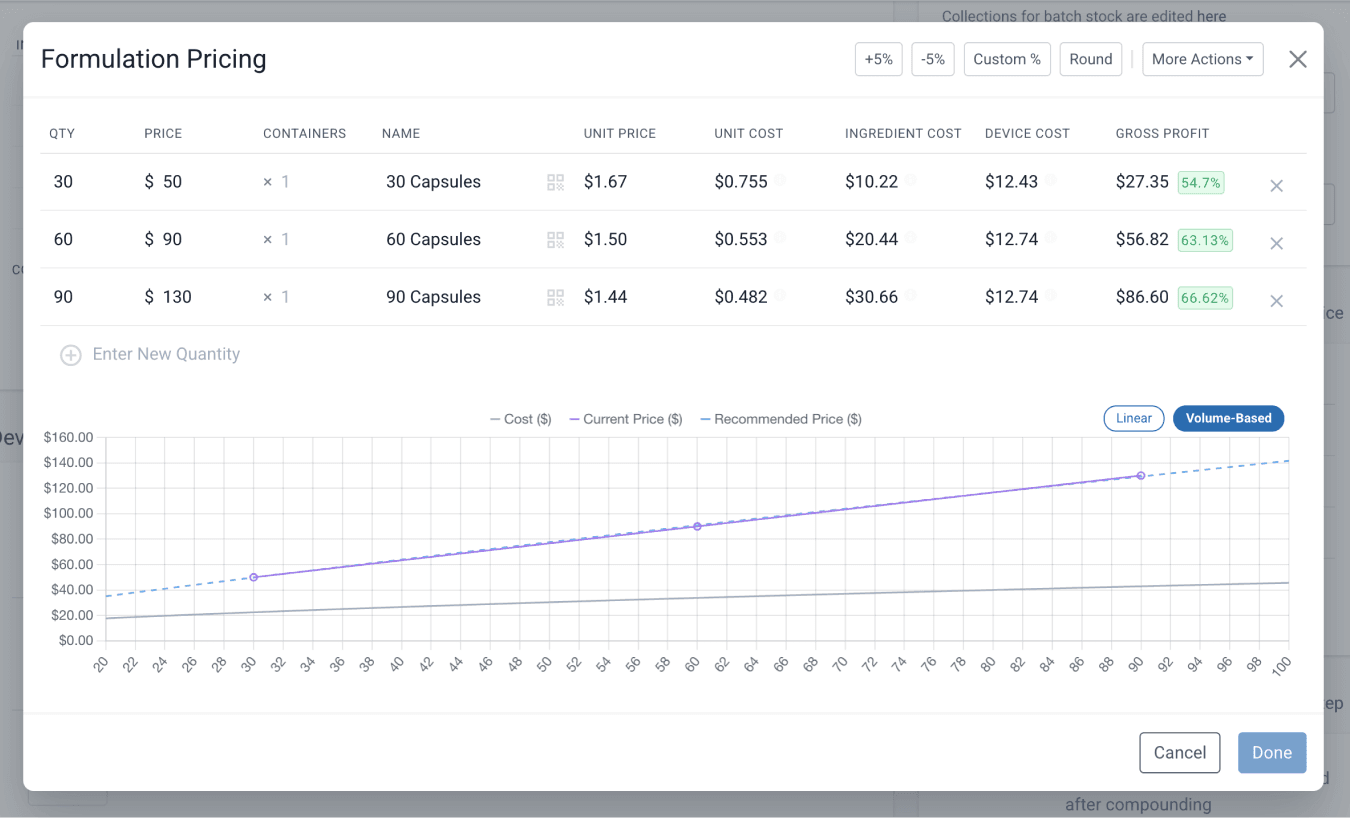
From the formulation page
When adding a price, you can view available pricing structures that may apply to the formulation as a guide, enter pricing per quantity, and name each price if needed, with a recommended Best Fit Price displayed to provide a smart suggested price based on the new quantity you enter.
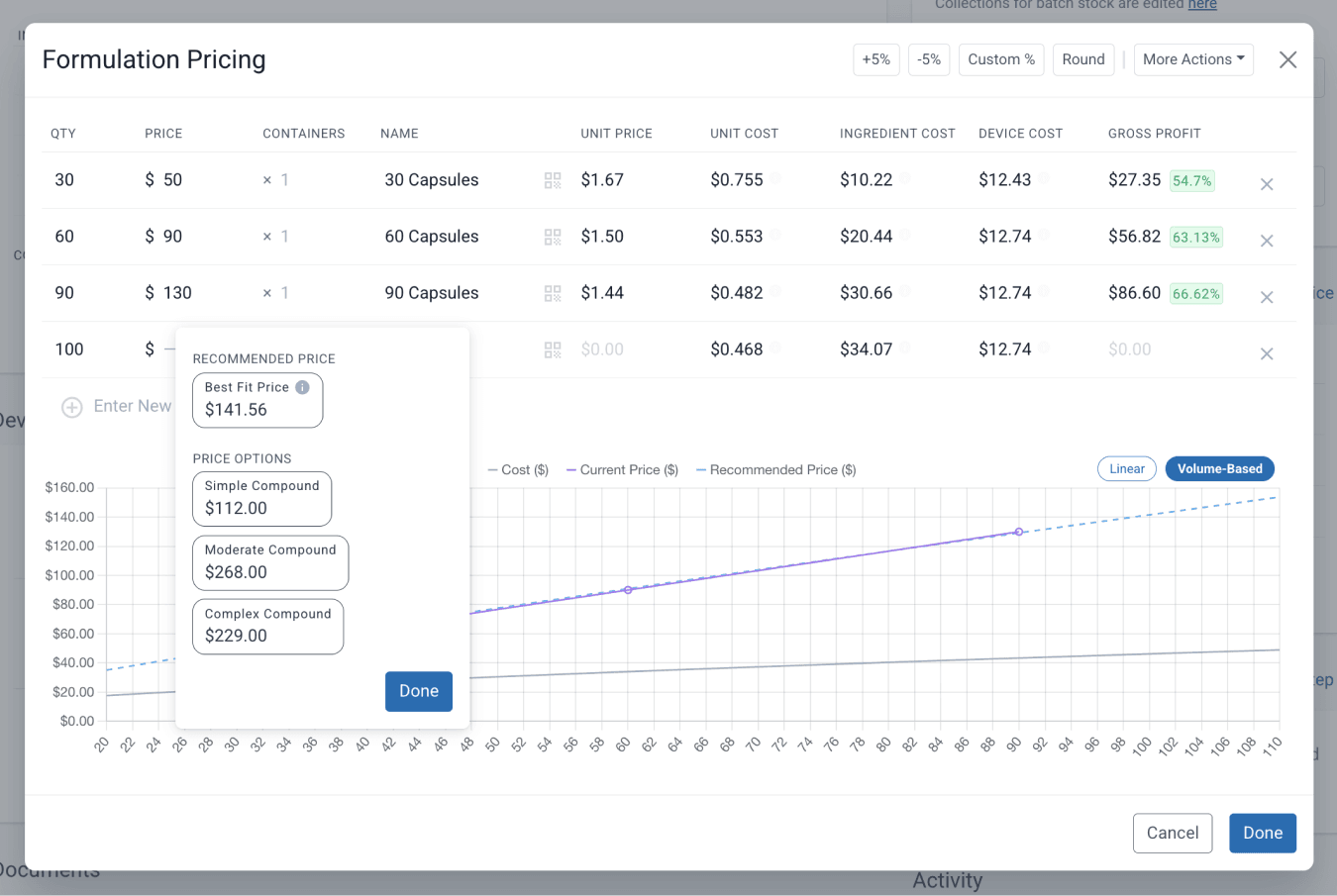
From the formulation price
Find Price
The Find Price option allows you to quickly check and add a price for a formulation using the available compound pricing structures.
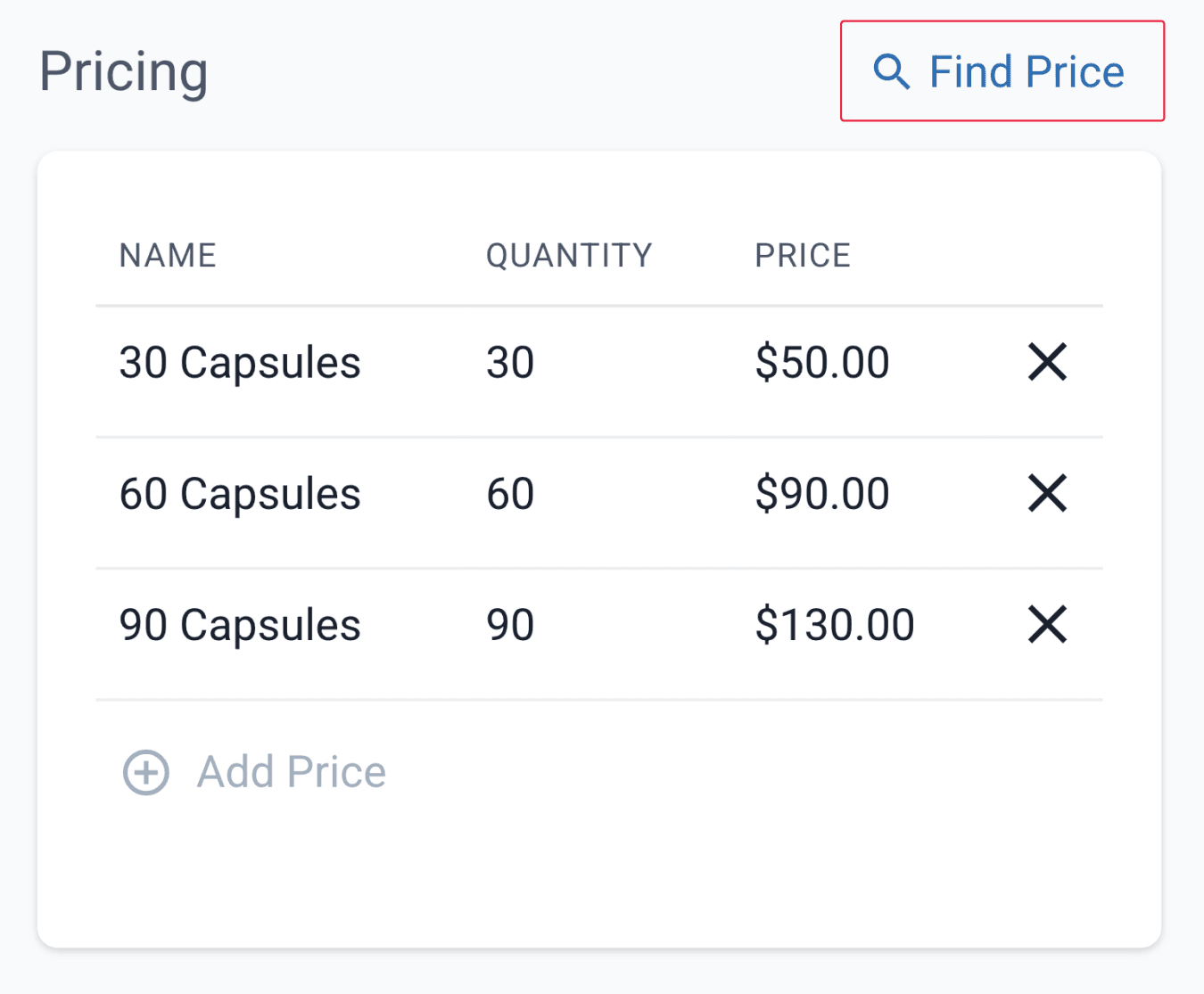
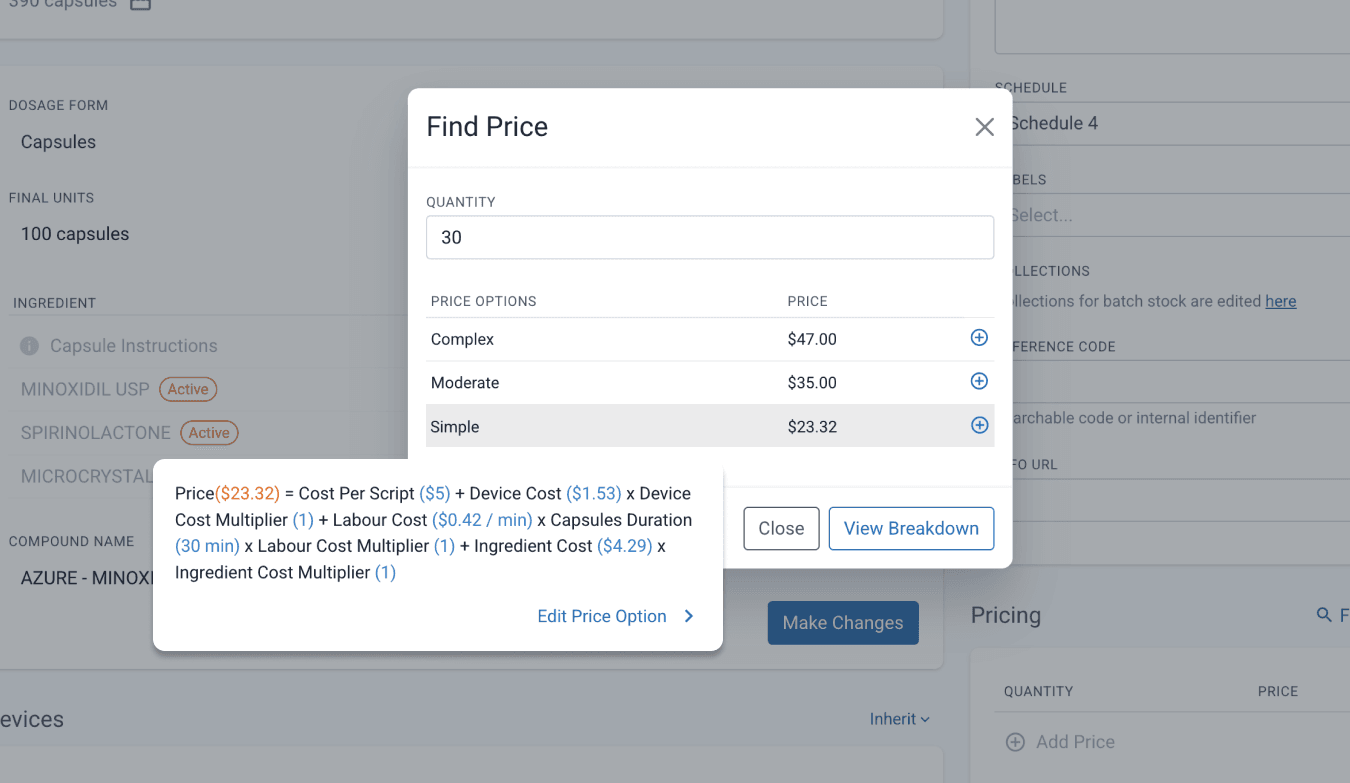
From the formulation page
Where would these prices take place?
Prices come into play at the draft stage, where you finalise how a compounded medication will be priced for a specific order. When creating a draft, you can choose a price based on Compound Pricing, Formulation Pricing, or enter a Manual Price.
If no Formulation Pricing exists, Compound Pricing is shown by default.
As you draft a medication, you can view the pricing options for that compound based on the pricing structures applied to the formulation. The more structures you apply to dosage forms, the more options will appear, while less restrictive structures will display more frequently when drafting formulations.
If you’re unsure how a price was calculated, you can hover over any of the tiles to view the full calculation.
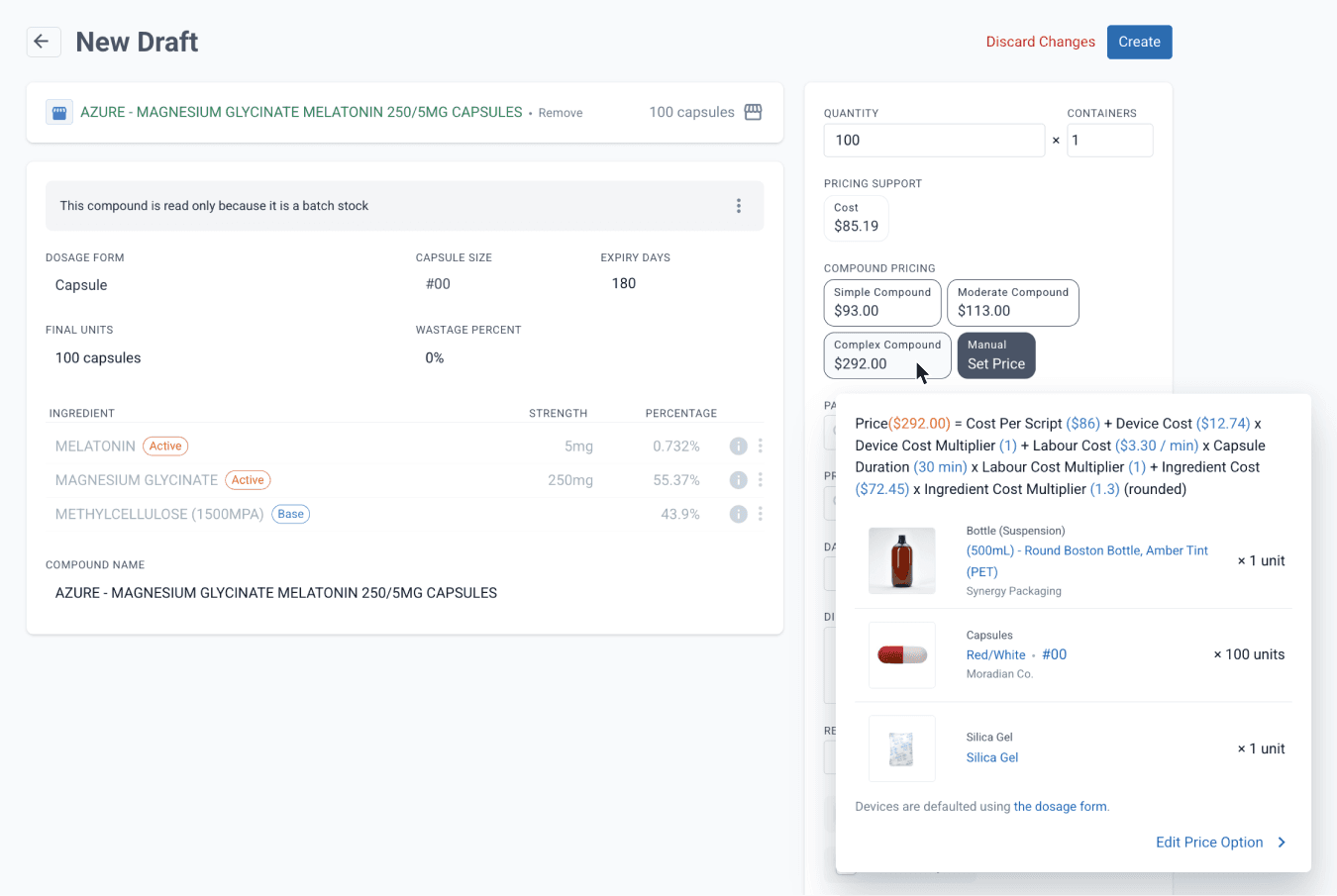
From the drafts page
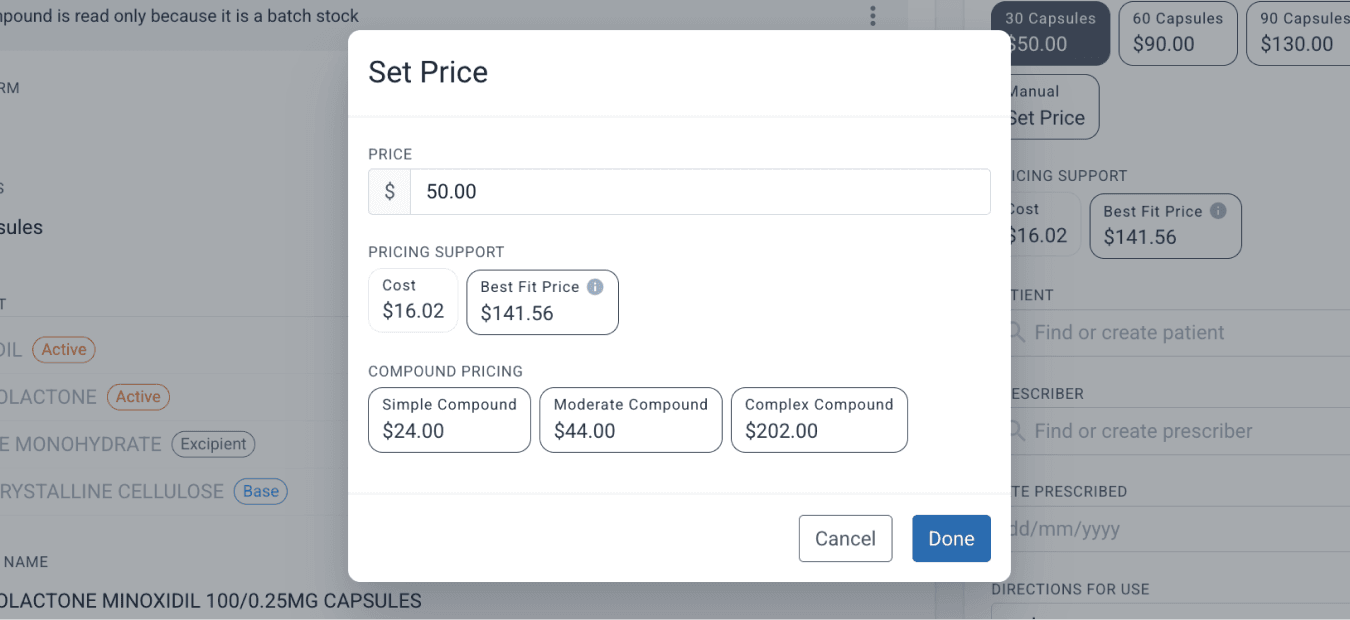
Once formulation pricing has been set up, those prices are displayed instead, giving you clear and consistent options to choose from. If the draft’s final unit quantity does not exactly match an existing formulation price, Compound Direct will recommend a Best Fit Price. This suggested price is calculated based on nearby quantities and existing pricing, giving you a logical and defensible option to use at the draft stage.
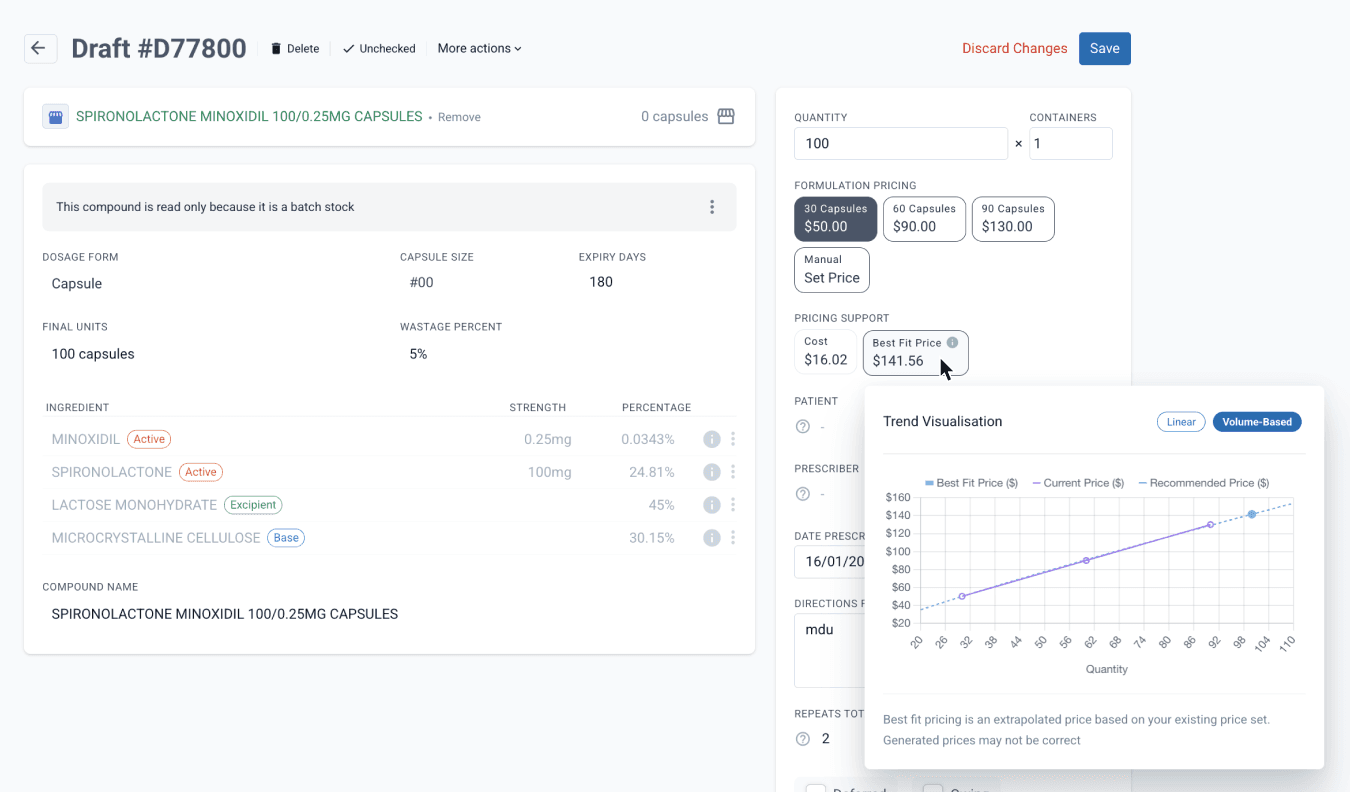
From the drafts page
You can also view the cost under pricing support, which displays the cost price and a detailed breakdown for quantities without available pricing.
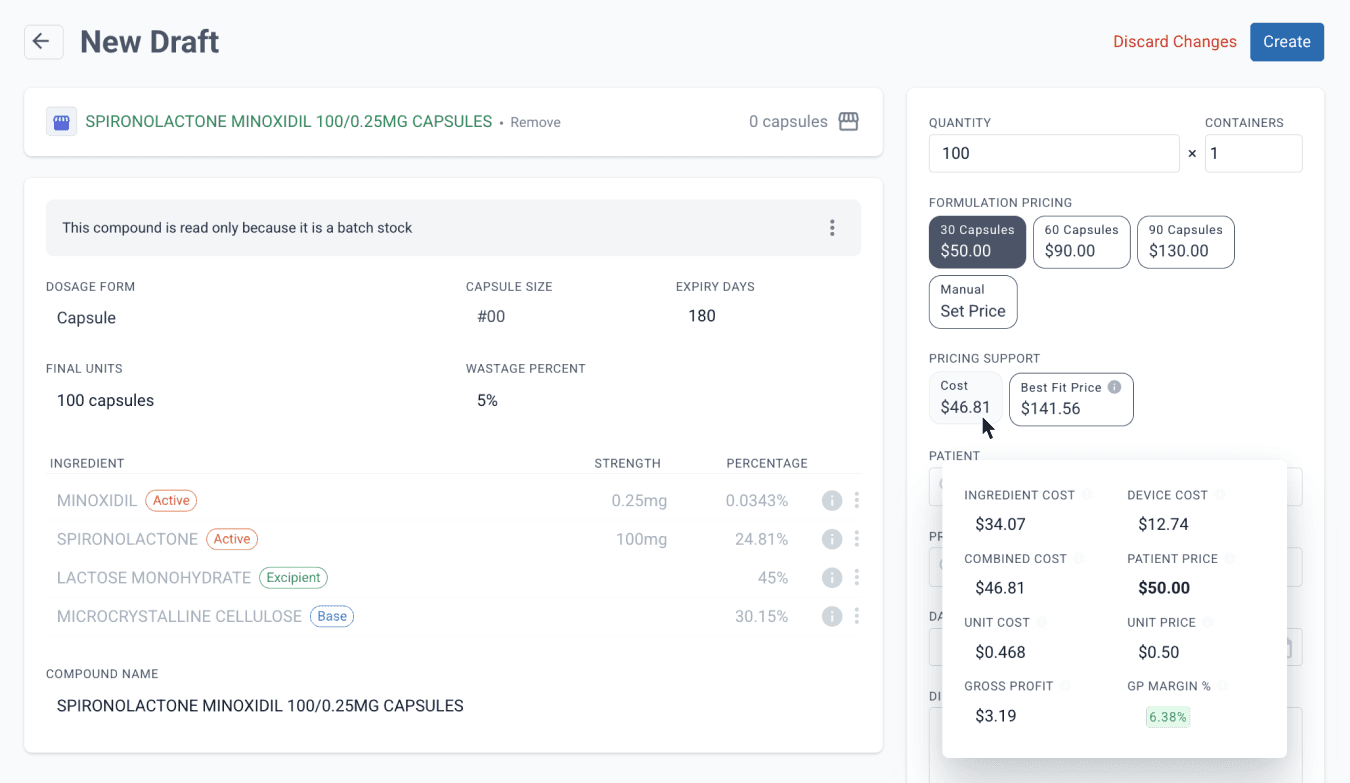
From the drafts page
Named prices will appear in the draft window for selection. If you’ve added prices to the formulation, click the ‘Manual - Set Price’ button to access all available pricing options, including multiple set prices for different scenarios such as per final unit, in-pharmacy, or B2B pricing.
From the drafts page
When to use compound pricing? (Pricing Structures)
Pricing structures are one tool in your pricing toolkit, providing guidance on how to price new formulations or quickly quote when asked “How much will it be to make…”. With real-time calculations in Compound Direct, you can stay informed if ingredient or device costs change, helping protect your margins from rising costs.
Ideal cases
- Real-time calculations of cost to estimate pricing that reduces margin erosion from various cost rises
- Fast quoting for new formulations, different formulation strengths, or variations in standard formulations
- Providing consistency in pricing across a range of dosage forms and formulas
- When you use a master formulation rather than creating multiple variations
When to use formulation pricing? (Set Prices)
Formulation pricing, or set prices, is useful when you want specific prices for a formulation rather than relying solely on pricing structures. This can be important for local competition, B2B agreements, or in-pharmacy deals, giving you flexibility while maintaining consistent and defensible pricing.
Ideal cases
- Competitive pricing on known value items (KVI)
- Set prices for B2B or in-store promotions or bundles
- Pricing for complex formulas such as high wastage trits or batch testing loss
- Setting prices for high or low final units where structures estimate sub-optimally
Pricing Structures vs Set Prices
There’s no one-size-fits-all answer when deciding whether to use pricing structures or set prices, and every pharmacy operates differently. Most pharmacies will use a hybrid approach, relying on pricing structures for overall estimates while applying set prices where the structures don’t quite fit.
The advantage of Compound Direct is that it brings together multiple sources of information in real time, allowing you to make informed pricing decisions. You can maintain multiple prices with clear names and transparent calculations, giving you the flexibility to adjust pricing while keeping consistency for your customers.
Testing, adjusting & testing again
We encourage you to take a bit of time to get to know the pricing structures by creating a few and then seeing how this affects the final prices. Test against low and high final units, low and high-cost active ingredients as well as how one pricing structure performs when used across different dosage forms.
Practical example
Let's say you’re making a new suppository and you want to know how much you should charge. You’ve made your formula and the costs are as follows:
1. Ingredients - $0.30 per supp.
2. Devices - $0.30 per supp (shell & misc. consumables) - If devices aren't available, you can add this to the base price to account for this cost.
3. Time to make - 60 mins
Let's assume the ingredients are all common and you don’t expect any to expire before using. We could use Pricing Structure A above. The final price to the patient for this formulation will be:
1. 30 suppos - $56.25
2. 60 suppos - $67.50
3. 90 suppos - $78.75
If the preparation was a complex one and you applied Pricing Structure B then the estimates would be:
1. 30 suppos - $103.80
2. 60 suppos - $132.60
3. 90 suppos - $161.40
This increased price accounts for more labour, ingredients that may expire before used or higher base costs related to storage or equipment needed.
Summary
Effective pricing balances accuracy, flexibility, and consistency. Pricing structures in Compound Direct provide automated, real-time calculations based on ingredients, labour, devices, and other costs. They are ideal for estimating new formulations and maintaining standard pricing across your lab. Set prices allow you to fine-tune pricing for competitive items, B2B agreements, promotions, or complex formulations where standard structures may not fit.
Using a hybrid approach with both pricing structures and set prices gives most pharmacies the best of both worlds. You get defensible, flexible pricing that adapts to cost changes while protecting margins. Regularly testing and adjusting your pricing ensures that each formulation remains profitable and consistent no matter how costs or quantities vary.
All names and medical data shown in software screenshots are fictional and for demonstration purposes only. These figures represent fictional persons; any resemblance to real individuals is purely coincidental. Use of existing fictional names is for illustrative purposes and does not imply affiliation or endorsement.