
Displacement Factors: The key to accurate molded dosage formulations

What are displacement factors?
Displacement factors play a crucial role in achieving accurate molded dosage formulations. They determine how much volume an ingredient occupies per gram, which in turn dictates how much base must be removed to maintain correct dosing. In molded dosage forms such as suppositories, lollipops, troches, gummies and pessaries, this calculation ensures each unit contains the intended amount of active ingredient. Without the correct displacement adjustment, too much or too little base may be used, resulting in inconsistent dosing, wastage, or excess product that does not meet therapeutic requirements.
In Compound Direct, displacement factors are integrated into automated calculations for each ingredient, drawing from batch specific values. Critical settings such as mold size, blank base weight, default displacement values and base density must be accurate to ensure reliable results. The system allows customisation for ingredients that behave differently in certain bases, and real time recalculations help bridge the gap between theoretical and practical weights during compounding. By applying precise displacement values, pharmacists can confidently produce consistent, high quality molded dosage forms that meet both formulation specifications and patient safety standards.
In this blog, we’ll break down how displacement factors work in Compound Direct, explain the critical values that influence accuracy, and walk you through practical examples to show how these calculations ensure consistent, reliable molded dosage forms.
Key Terms
Molded dosage form: A fixed volume dosage that contains a semi solid base and/or active ingredients. Examples include suppositories, lollipops, troches, gummies and pessaries.
Blank: A molded dosage form that contains only the base.
Density: The weight of 1 mL of an ingredient.
Base: The semi solid material used to form the finished product, such as SPG, Witepsol or NataTroche.
Role of Displacement
When creating a formulation, you must determine how much base to remove from the mold to ensure each unit contains the correct dose of active ingredient. Removing too much or too little base will cause the molds to hold an incorrect amount of active ingredient.
For example, if you are making 10 suppositories containing 5 mg of diazepam each, you will weigh 50 mg of active ingredient to divide evenly across the 10 units. If you do not remove enough base and are left with excess suspension after filling the molds, each suppository will contain less than 5 mg because some of the diazepam will be discarded with the excess. (This is different from the wastage percentage.) Conversely, if you remove too much base and fill the molds unevenly, some units may contain more than 5 mg while others contain less, resulting in inconsistent dosing.
Important values
When developing a formulation, certain values must be set correctly in Compound Direct to ensure accurate final product calculations.
Mold size
This is the recorded capacity of a single mold cavity in milliliters (mL), used to calculate the target weight each unit should contain. When excipients are added as a percentage to the formulation, the percentage is based on the theoretical final weight. You can create any number of combinations of bases, mold sizes, and blank weights, in the dosage forms settings.
Blank base weight
The blank weight determines the amount of base required to fill the mold and is entered in the dosage form settings. If you change the base, you may also need to update this value.
Default displacement value
This is the displacement factor automatically applied to all powdered ingredients unless a different value is specified for that ingredient. You can set a default displacement value in dosage form settings.
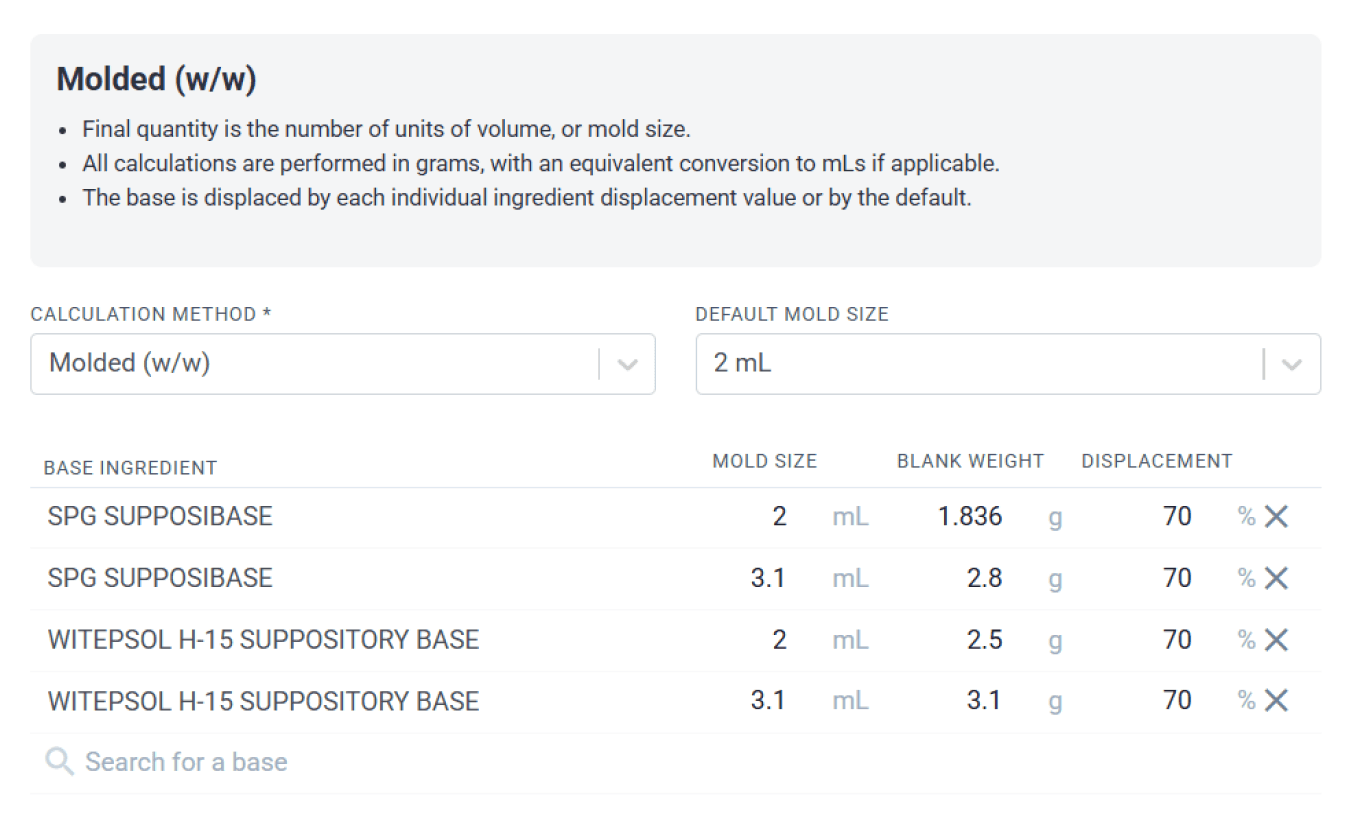
From the dosage forms page
Ingredient displacement value
If a powder does not displace by 70%, or by the dosage form default, a specific displacement value must be set at the ingredient batch level.
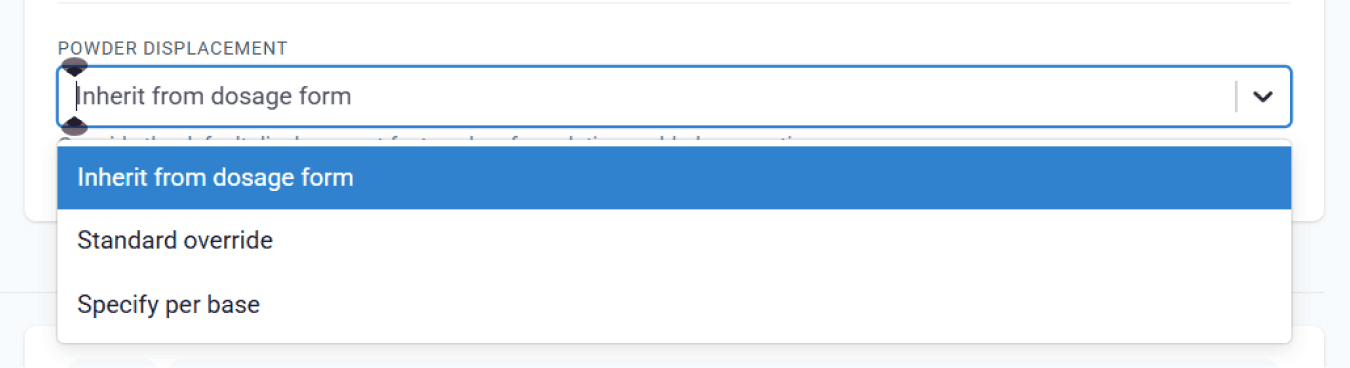
From the ingredient batch page
Setting displacement options
Within the settings of each ingredient batch, you can alter the displacement factor to account for how that particular ingredient and batch displaces bases.
The displacement can be set as a ‘Standard Override’ or ‘Specify per base’. This allows for additional customisation if the ingredient behaves differently in certain bases.
Standard Override
Sometimes the default displacement factor set at the dosage form level may not perfectly suit your formulation. This is where the Standard Override comes in. It allows you to adjust and override that default value, ensuring your calculations reflect the unique characteristics of your ingredients and base. By using the override, you maintain flexibility while still keeping accurate dosing at the forefront.
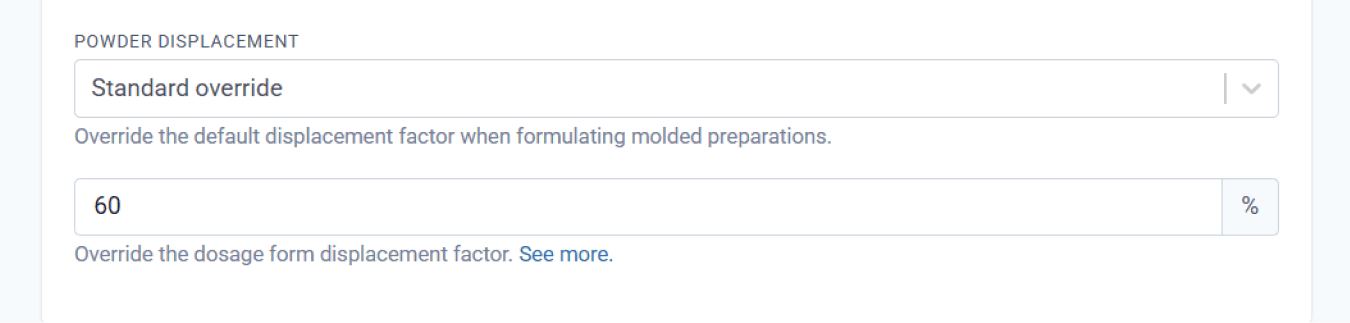
From the ingredient batch page
Specify Per Base
In some cases, you’ll want even more precision. Specify Per Base allows you to set a displacement factor for an individual base within the dosage form. Since different bases behave differently, this option ensures your calculations reflect the unique characteristics of the base you’re working with.
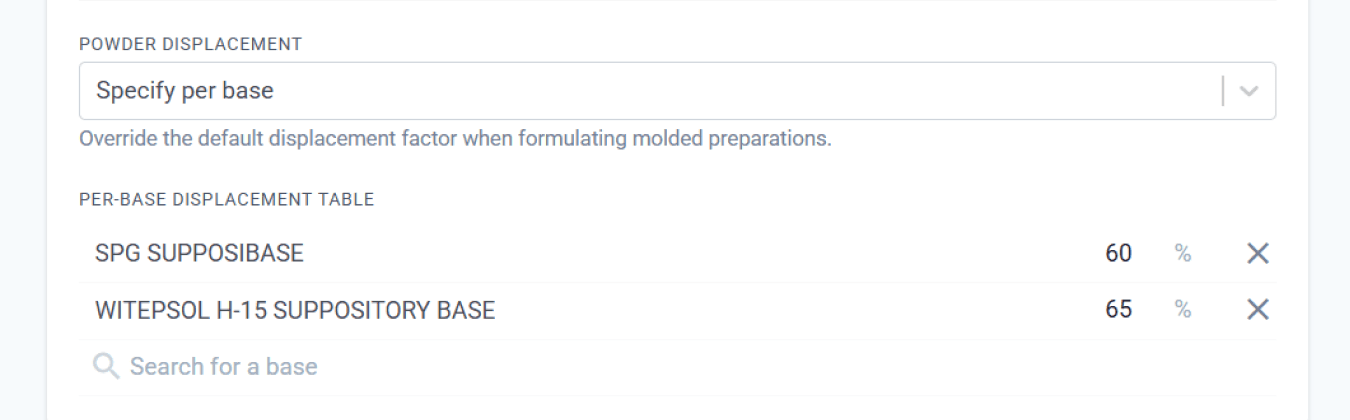
From the ingredient batch page
Base density
If you convert any powders into mL, you will need to know how to calculate an adjustment factor based on the weight, which will require a multiplication of its density. Blank weights are calculated based on this value and can be used to calculate the base density by dividing the blank base weight by the volume
Behind the formula
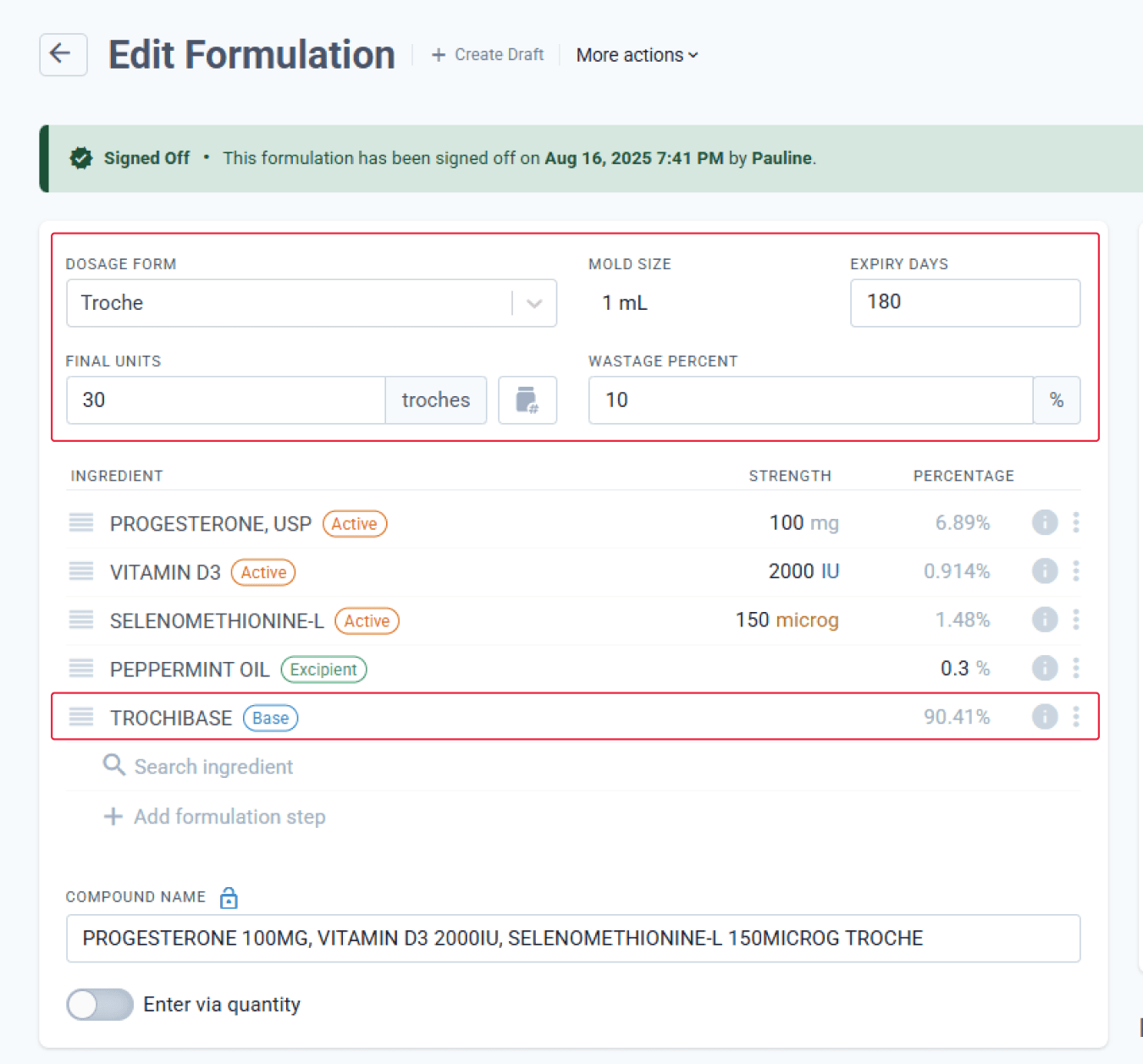
In the formulation below, you’ll see several key details: dosage form, mold size, number of final units, wastage percentage, and percentage of base. Ensure each of these values is correct before proceeding, as even small errors can affect the accuracy of the calculations.
From the formulations page
In the above formulation, you can see several key details: the dosage form, mold size, number of final units, wastage percentage, and percentage of base. Make sure each of these is correct before continuing, as any incorrect information could affect the accuracy of the calculations.
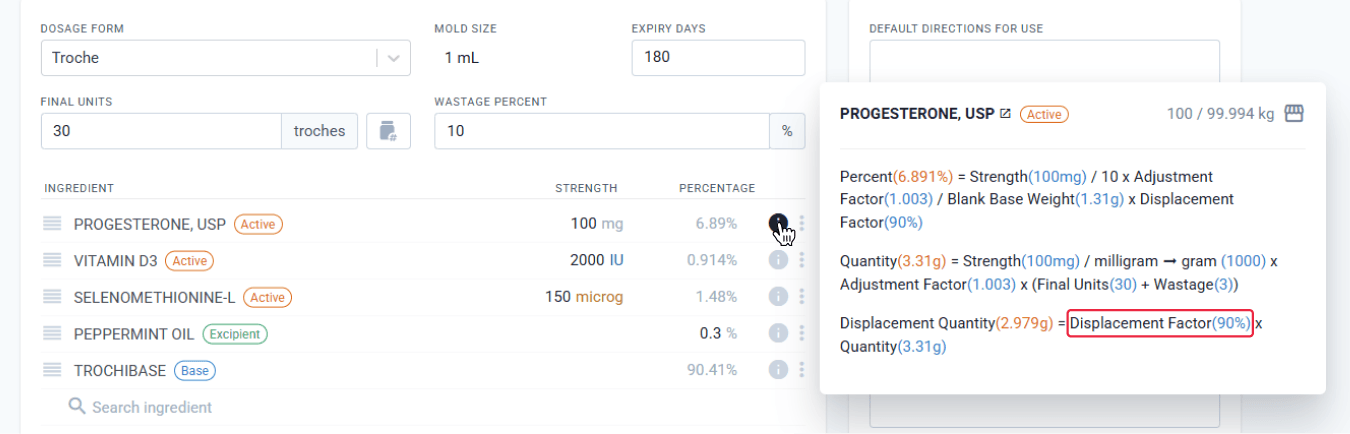
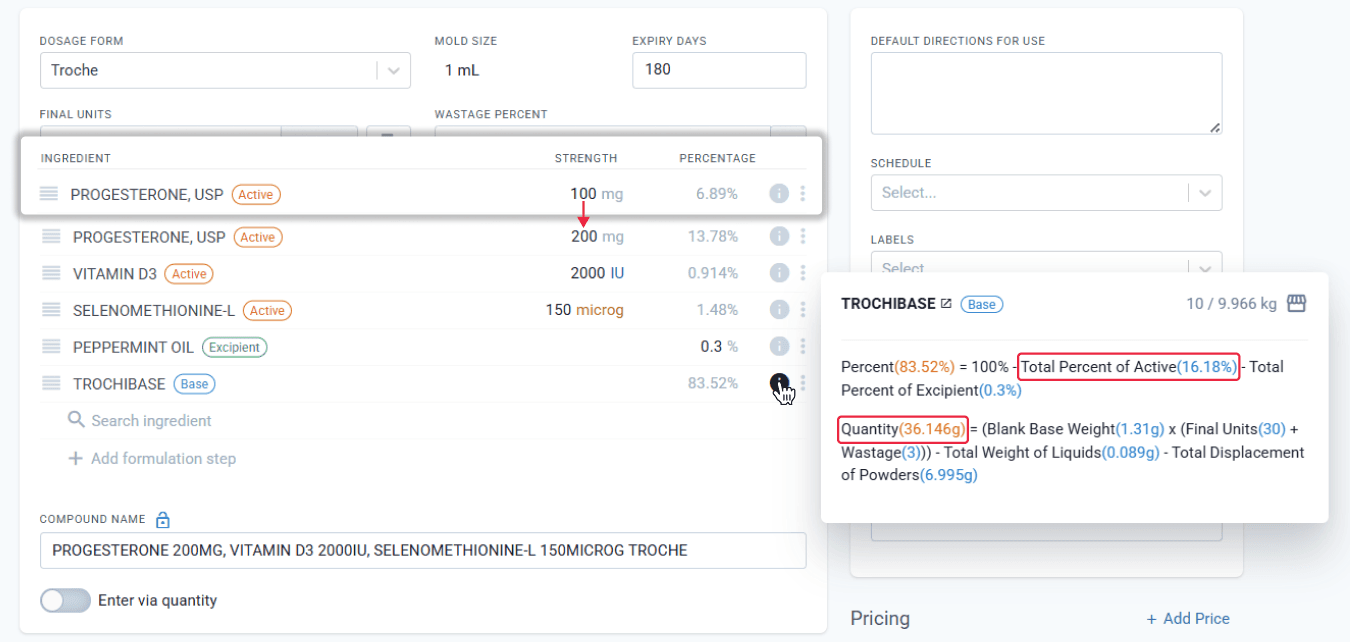
On the formulation page, hover your cursor over the ⓘ icon to view the automated calculations being performed in the background for each ingredient.
Highlighted in this illustration is Progesterone, with a displacement factor of 90%;
From the formulations page
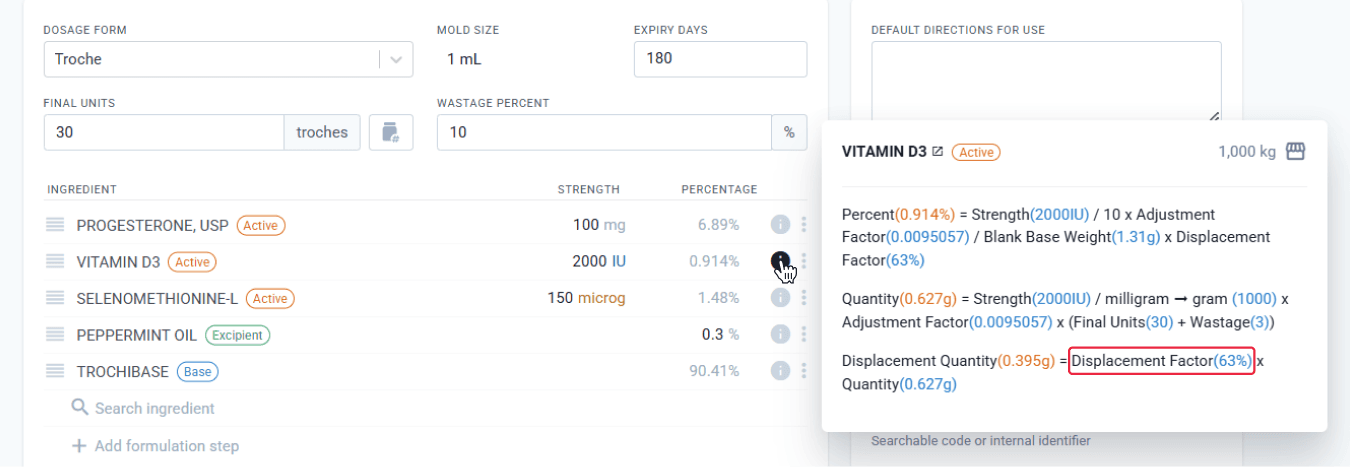
Vitamin D3 has a displacement factor of 63%;
From the formulations page
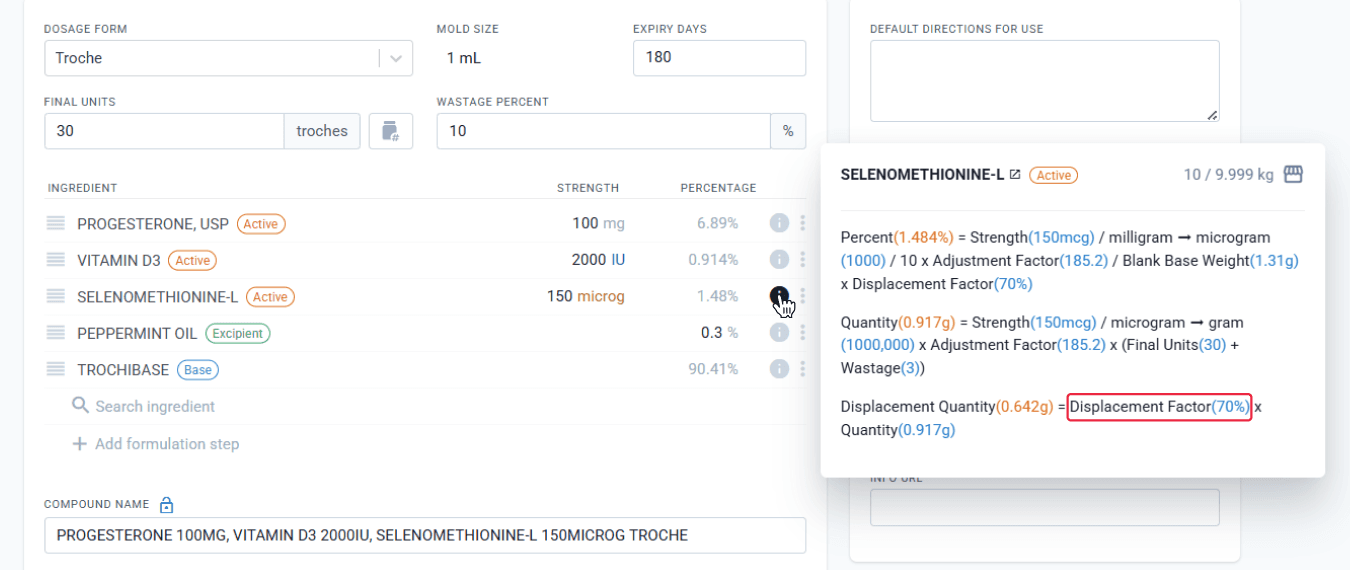
Selenomethionine-L has a displacement factor of 70%, and these actives will displace different amounts of the base.
From the formulations page
You may review the base calculations, strength of actives, final quantity of troches, wastage, and the displacement values of both liquids and powders. If you adjust the strength of the actives, the system will automatically recalculate the formulation to reflect those changes.
From the formulations page
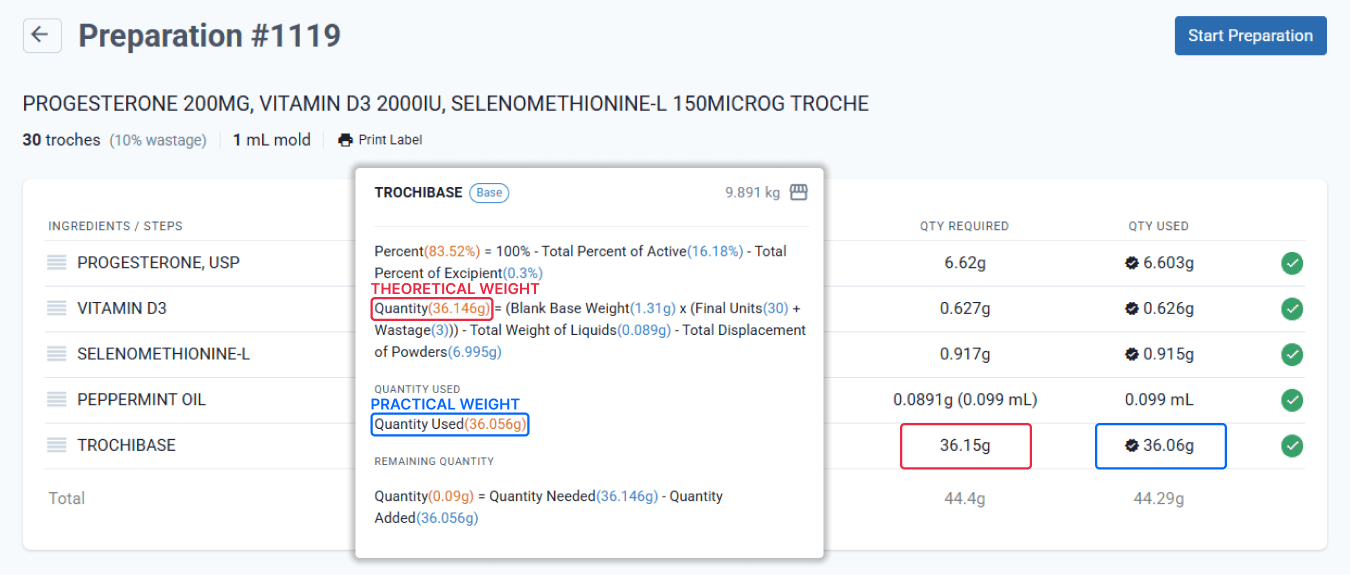
Immediately, all necessary calculations are automatically performed to ensure the theoretical base weight is correct. Once established, you may proceed with compounding this formulation.
From the preparation page
After the ingredients are weighed, you will notice that the quantity of the trochibase has changed slightly. Initially, we were required to weigh 36.146 grams, but now it has changed to 36.056 grams. This is because there is a discrepancy between the theoretical weight, and the practical weight.
Theoretical vs Practical Weight
When compounding, it is important to understand that the theoretical weight of an ingredient, the calculated amount based on formulation formulas, may differ slightly from the practical weight, which is the actual amount measured on a scale. These small differences occur due to measurement tolerances and the physical properties of ingredients. The system accounts for this by recalculating the base in real time to ensure the correct amount is used, maintaining consistent dosing across units. Practical testing or formulations from reputable sources should take precedence over theoretical calculations, as they provide the most reliable guidance for accurate compounding.
Troubleshooting the differences
When the calculation from Compound Direct differs from a reputable source, it is important to review your dosage form settings, displacement value settings, and ingredient/batch settings. The most common reasons for discrepancies are:
Incorrect mold size
Double-check the formulation provided. If the Compound Direct formulation has a different mold size, adjust it and recheck.
Change in base
As explained above, the correct amount of base depends on the Blank Weight in the dosage form. If you are using a different base from the default, create a new dosage form with the correct blank weight and recalculate.
Incorrect displacement factor for the base
Certain bases may have a different default displacement value. For example, gelatin or gummy bases often have a higher displacement value than a troche or PEG base. Refer to the ingredient documentation and adjust accordingly.
Ingredient-specific adjustment
Some ingredients may have different displacement values, such as wettable or micronized versions. Review the documentation for each ingredient and adjust as required.
Excipient variations
Some provided formulations may use more or less excipient than the default, especially when flavors are added. Ensure the weight of the excipients matches the provided formulation and adjust as needed.
Formulation calculation method
Over time, with more practical testing, the way molded dosage forms are calculated may change. This can result in adjustments to displacement values or excipient loads. Review the calculation method with the formulation provider and adjust accordingly.
Adjustment factors
Compound Direct adjusts the amount of active ingredient based on the ingredient’s adjustment factor. Some provided formulations may not account for potency changes and may therefore differ. Review these against the provided formulation to ensure potency is considered.
Summary
The displacement factor determines how much volume an ingredient occupies in a formulation, guiding how much base should be removed when adding ingredients to ensure each unit receives an accurate dose. Accurate displacement calculations are crucial because using too much or too little base can lead to inconsistent dosing across units. Key parameters include the mold size, which defines the total volume to be filled, and the blank weight, which is the base weight required to fill the mold. The default displacement value for powdered ingredients is also important, as is the base density when converting powders to volume measurements.
Displacement can be customised using either a Standard Override or Specify per Base approach to account for different ingredient behaviors. Common sources of discrepancies include incorrect mold size, changes in the base, inaccurate displacement factors, and ingredient specific variations. Practical testing and reference formulations from reputable sources should take precedence over purely theoretical calculations. Additionally, separate dosage forms should be created for different bases to avoid manual adjustments, ensuring consistency and reliability across all units.
All names and medical data shown in software screenshots are fictional and for demonstration purposes only. These figures represent fictional persons; any resemblance to real individuals is purely coincidental. Use of existing fictional names is for illustrative purposes and does not imply affiliation or endorsement.