
Automatic Bulk Allocation: Streamline multi-script management with audit-ready allocations

Automatic bulk allocation allows your pharmacy to automatically assign an internal batch manufacture record to multiple scripts before preparation is complete. Instead of waiting until the batch has been compounded and signed off, your team can prepare allocation workflows and labels earlier while maintaining clearer traceability across the compounding process.
This blog focuses on bulk allocating an internal batch stock when automatic allocation is enabled. It covers what internal batch stock and automatic allocation mean, when this workflow is useful, and how to bulk-allocate multiple scripts to a single internal batch manufacture record in Compound Direct.
Feature highlights
✔ Faster allocation across multiple scripts
Assign the same internal batch manufacture record to multiple identical scripts at once to reduce repetitive processing and streamline dispensing workflows.
✔ Flexible internal workflow support
Use automatic allocation when your pharmacy wants to prepare allocation and labelling workflows before the batch is compounded and signed off, so your team can reduce delays during busy dispensing periods.
✔ Stronger traceability and audit readiness
Maintain clearer links between patients, scripts, and batch manufacture records to support recalls, investigations, final checks, and compliance workflows.
The TGA requires compounded medicines to be prepared in response to a prescription for an identified patient. As a result, Australian pharmacies cannot routinely manufacture and hold surplus compounded stock without risking non-compliance through anticipatory compounding.
Compound Direct is designed to support pharmacies operating within these requirements. By maintaining prescription-level traceability throughout the dispensing and batch allocation process, the platform enables efficient workflow management while helping pharmacies meet their regulatory obligations with confidence.
What is internal batch stock?
Internal batch stock refers to compounds prepared within your pharmacy. These records do not include manufacturer-issued batch numbers, printed expiry labels, or external manufacturing documentation because the preparation process is managed internally.
This is commonly used when a pharmacy needs to prepare a larger quantity of a product for multiple matching scripts, depending on demand. In Compound Direct, the batch manufacture record acts as the central reference point for quantity, preparation status, allocation, and final sign-off, helping ensure each script remains linked to the correct internally prepared batch.
What is automatic allocation?
Automatic allocation, when enabled, allows Compound Direct to automatically pre-allocate multiple identical dispensed scripts when a single batch manufacture record is created. This helps your pharmacy prepare allocation workflows earlier in the process.
In your workspace, this feature is referred to as Conditional Allocation. It is available at no additional cost for workspaces on Standard packages. Please contact Compound Direct's support team for more information.
Setting up automatic bulk allocation
This workflow is commonly used by pharmacies that prefer to start allocation workflows before compounding and pharmacist verification is complete.
Note: For this walkthrough, we will use a formulation that has already been converted into batch stock. The purpose of this example is to demonstrate how the Automatic Bulk Allocation feature automatically assigns multiple matching scripts to a single batch manufacture record.
A single batch manufacture record will be created to fulfil these prescriptions, allowing your team to review allocations, bulk-print labels, and then proceed with preparation and sign-off while maintaining full traceability to each patient script.
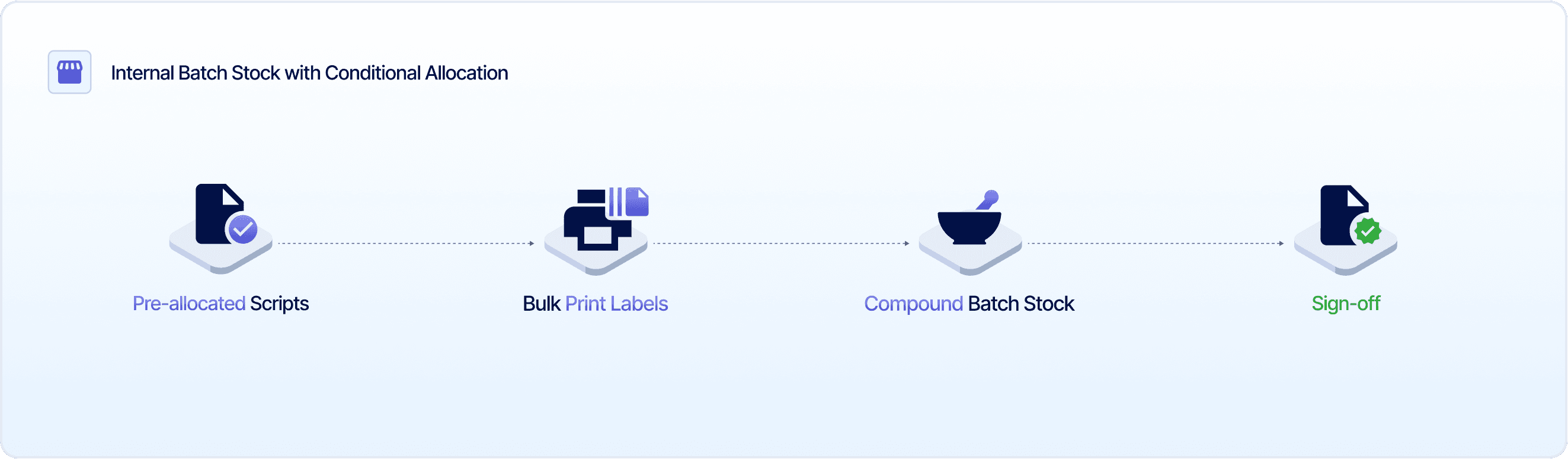
In this scenario, your pharmacy has received five identical prescriptions for Ascorbic Acid 300 mg oral troches, which have been drafted and dispensed but not yet allocated. This allows you to bulk allocate the available stock before finalising the dispensed prescriptions.
Step 1: Create a batch manufacture record
On the Dispensed dashboard, click on the ‘Type’ drop-down menu and narrow down the list by leaving only the ‘Batch Stock’ checkbox ticked. The list will only display batch stock records.
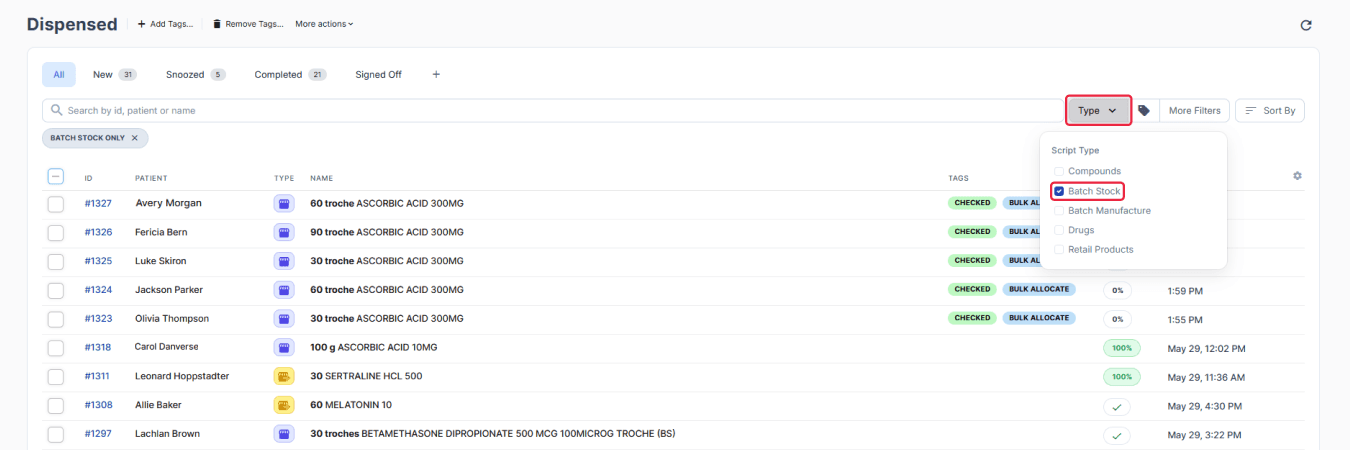
From the dispensed dashboard
After locating the desired batch stock, click the three dots icon and select ‘Show Identical’ from the drop-down menu.
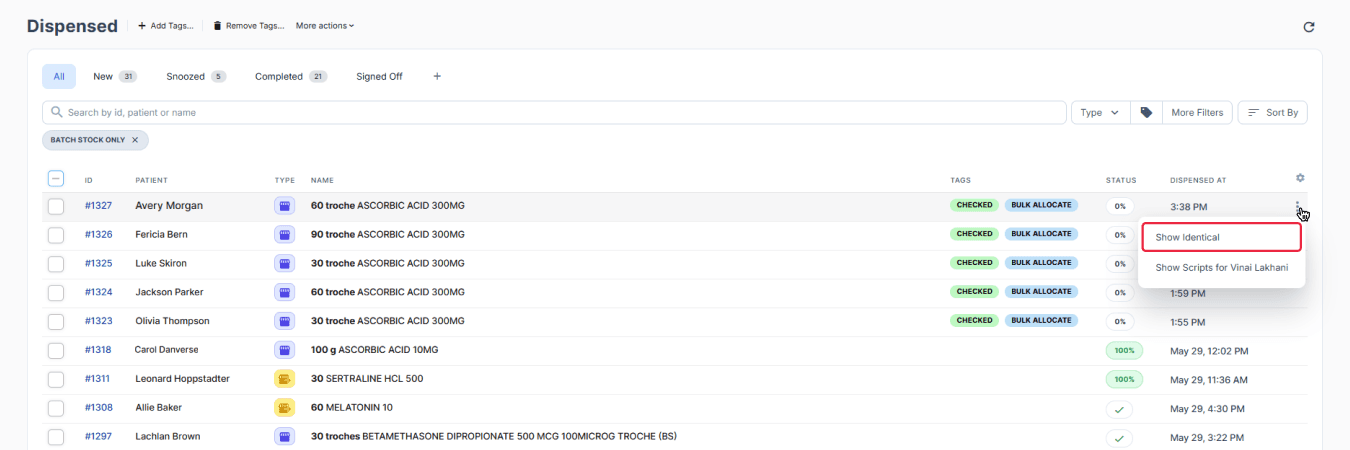
From the dispensed dashboard
Tick the uppermost checkbox to select all identical batch stock scripts, then click ‘Prepare Batch Manufacture’.
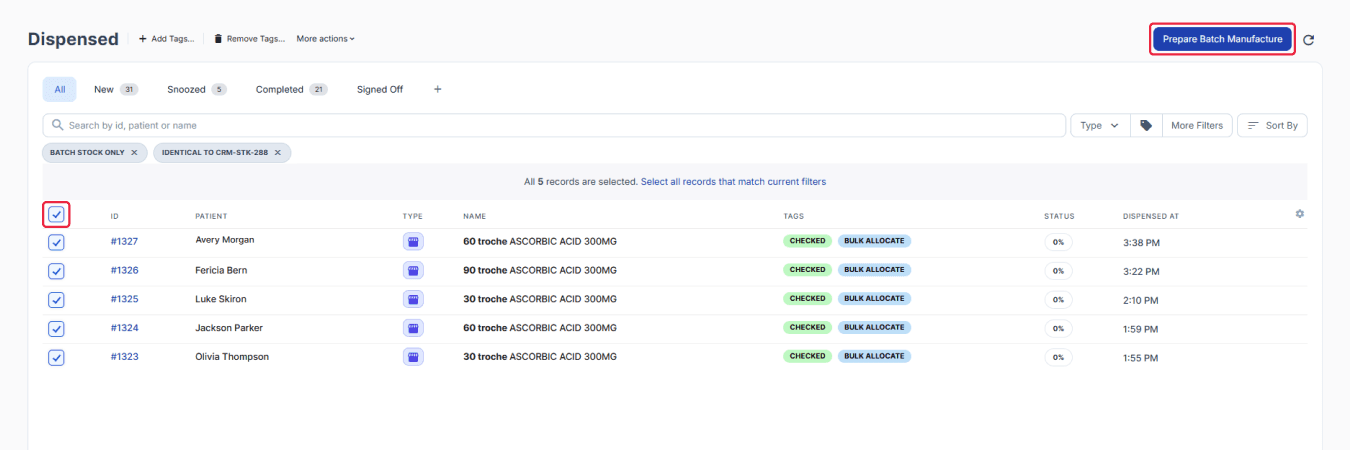
From the dispensed dashboard
The system will automatically enter the required total quantity for all scripts. Click ‘Create Batch Manufacture’ to proceed.
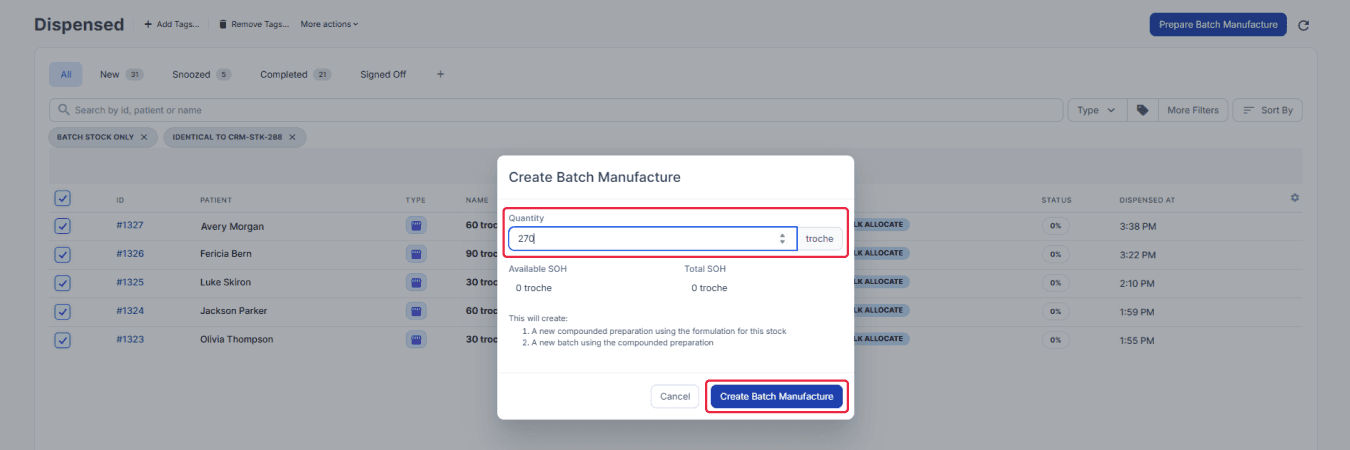
From the dispensed dashboard
You will be redirected to the Stock Batch page with an overview of the automatically pre-allocated scripts.
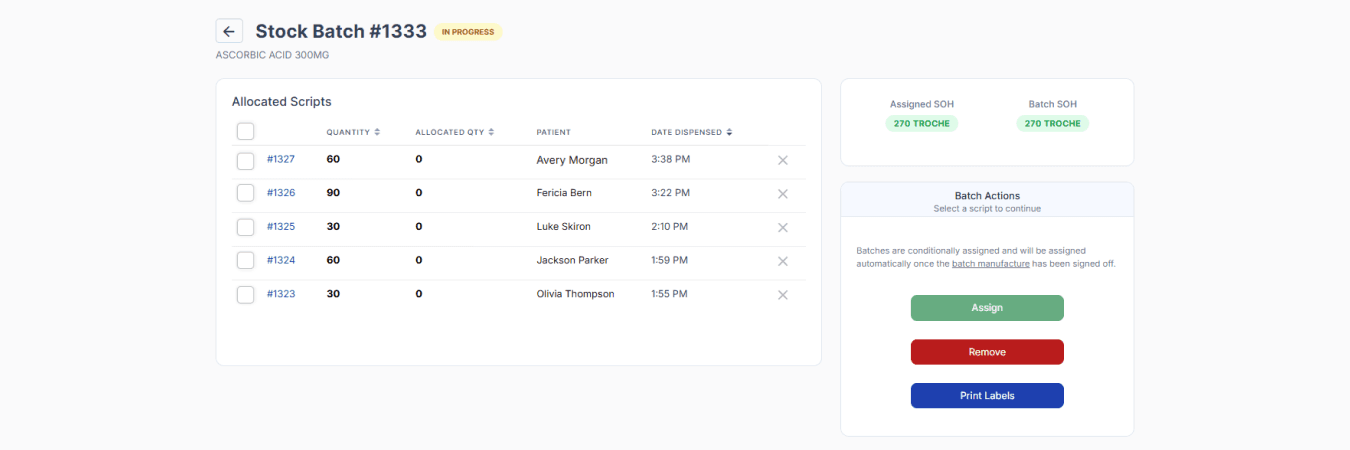
From the stock batch page
Step 2: View and manage pre-allocated scripts
On the Stock Batch page, the scripts remain tentatively pre-allocated until the dispensed scripts are signed off.
During this stage, you can still remove pre-allocated scripts by ticking the checkbox of the required script and clicking ‘Remove’ or the X button for each dispensed record, if there’s a need to un-allocate a script.
Once all stock on hand (SOH) has been allocated, additional scripts cannot be assigned to a batch.
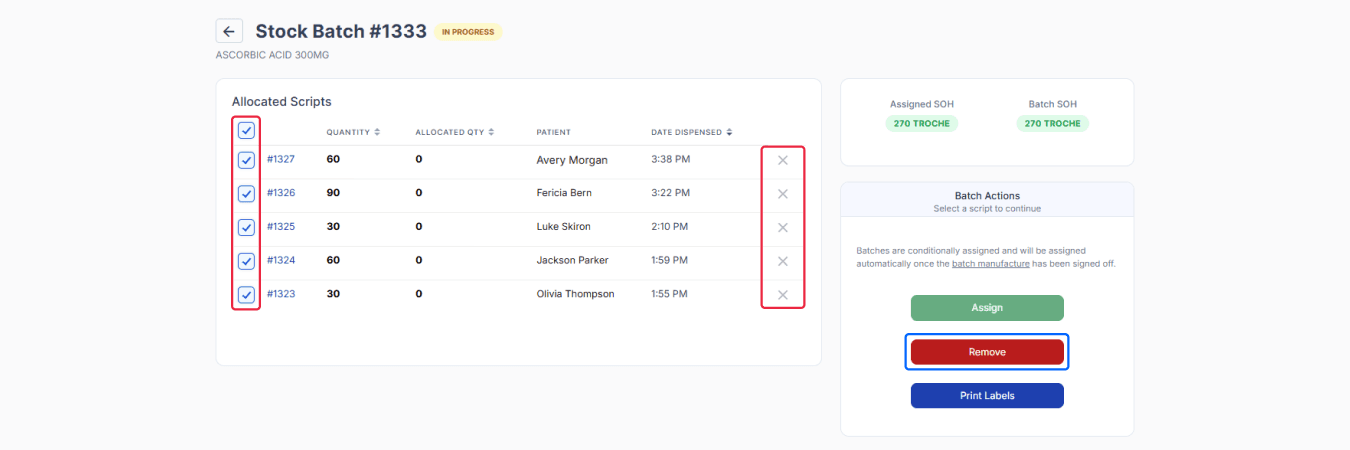
From the stock batch page
Tick the uppermost checkbox to select all allocated scripts, then click ‘Print Labels’ to bulk print the labels.
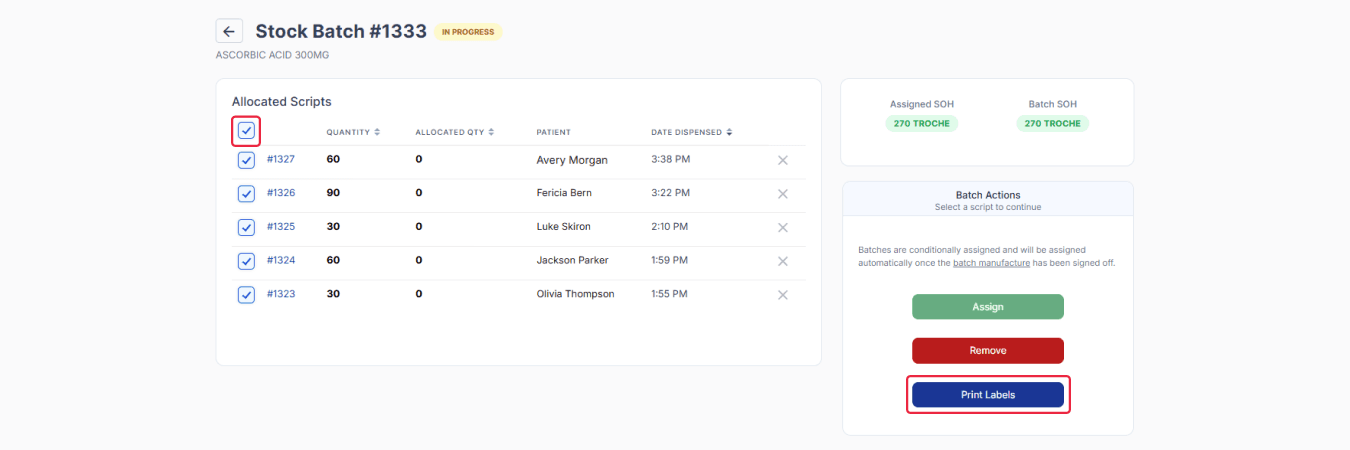
From the stock batch page
Note: When labels are printed at this stage, the stock may appear as allocated on the Stock Batch record, even though the scripts are only tentatively allocated.
Select the required label variant, printer, and paper type settings from the drop-down menus. If needed, tick the checkbox to save the printer as the default device, then click ‘Print’.
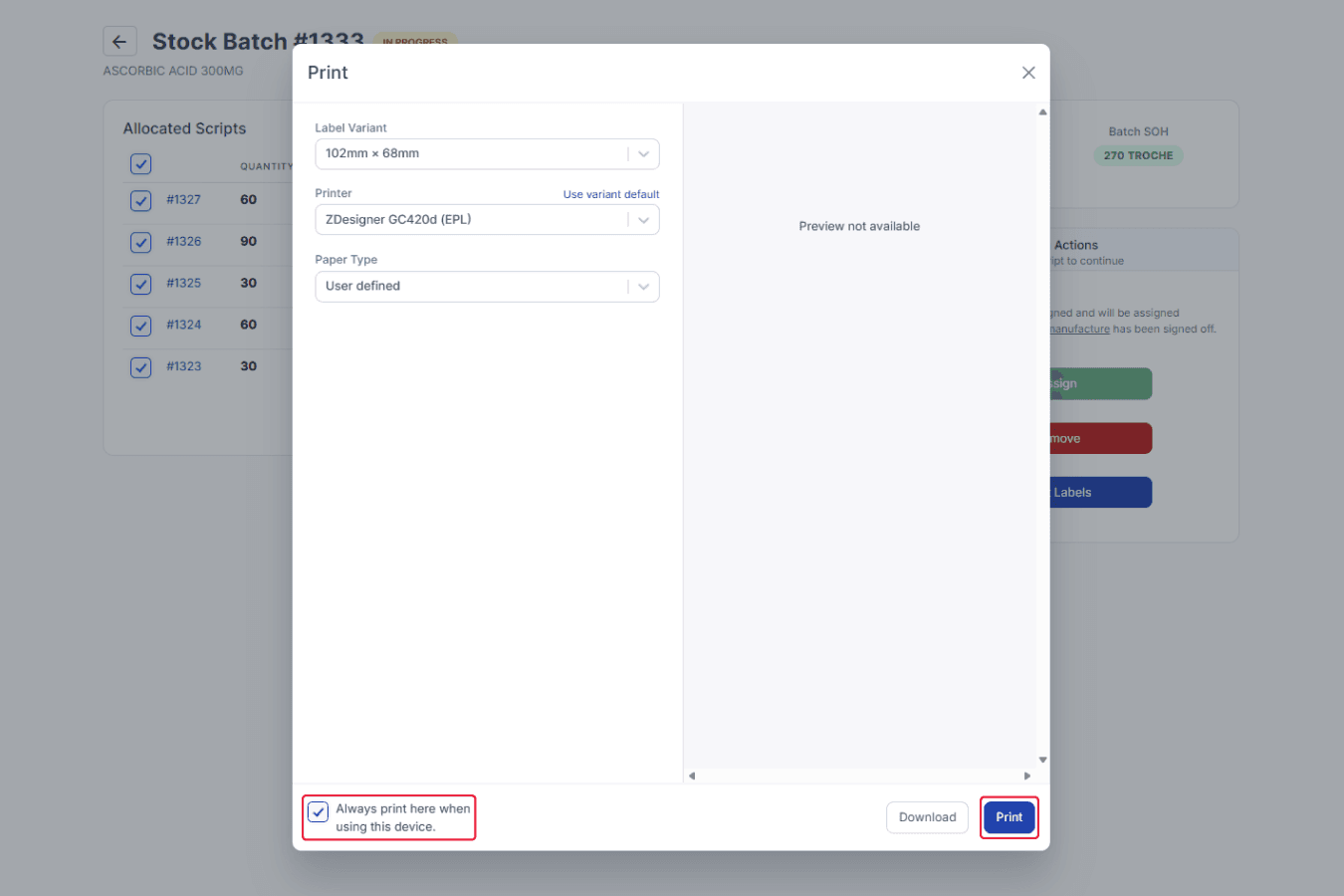
From the stock batch page
Step 3: Complete preparation and sign-off
To continue with batch preparation, click the ‘In Progress’ badge. This will return you to the Batch Manufacture page, where you can proceed with the remaining preparation and sign-off steps.
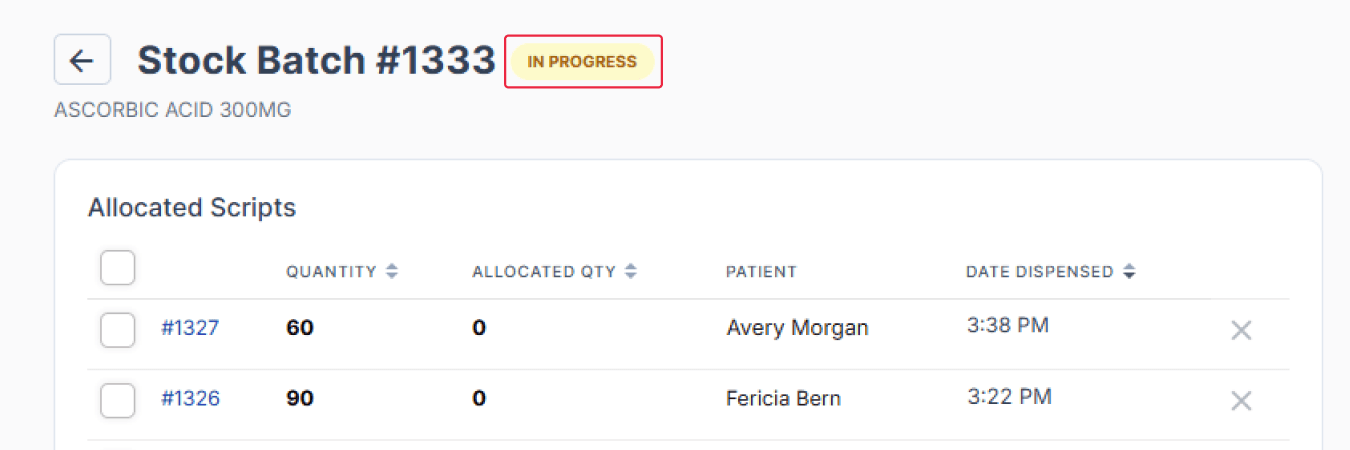
From the stock batch page
On the Batch Manufacture page, click ‘View Preparation’.
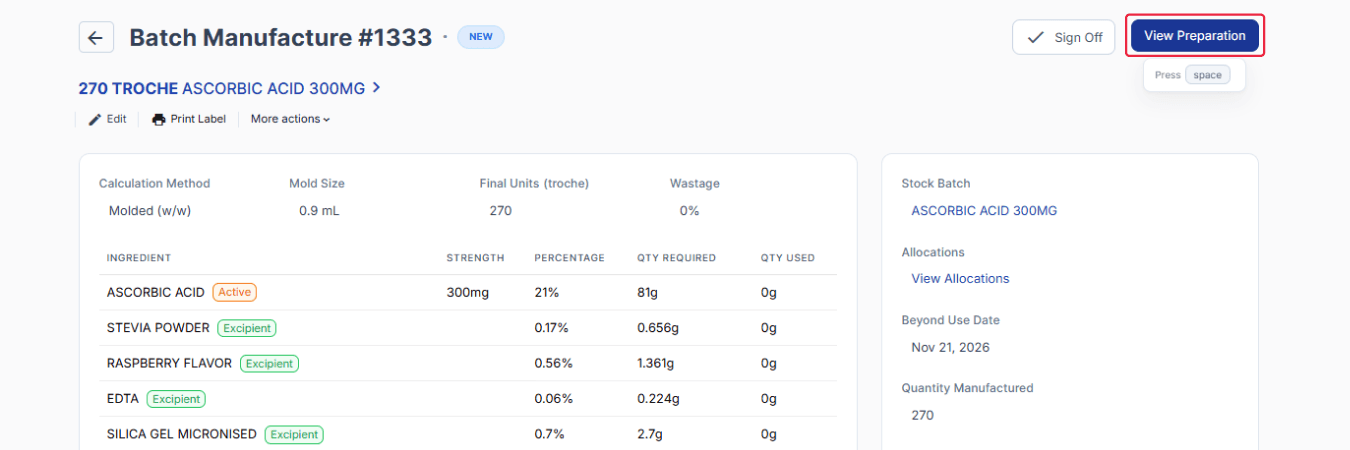
From the batch manufacture page
Click ‘Start Preparation’ and follow the formulation steps until preparation is complete.
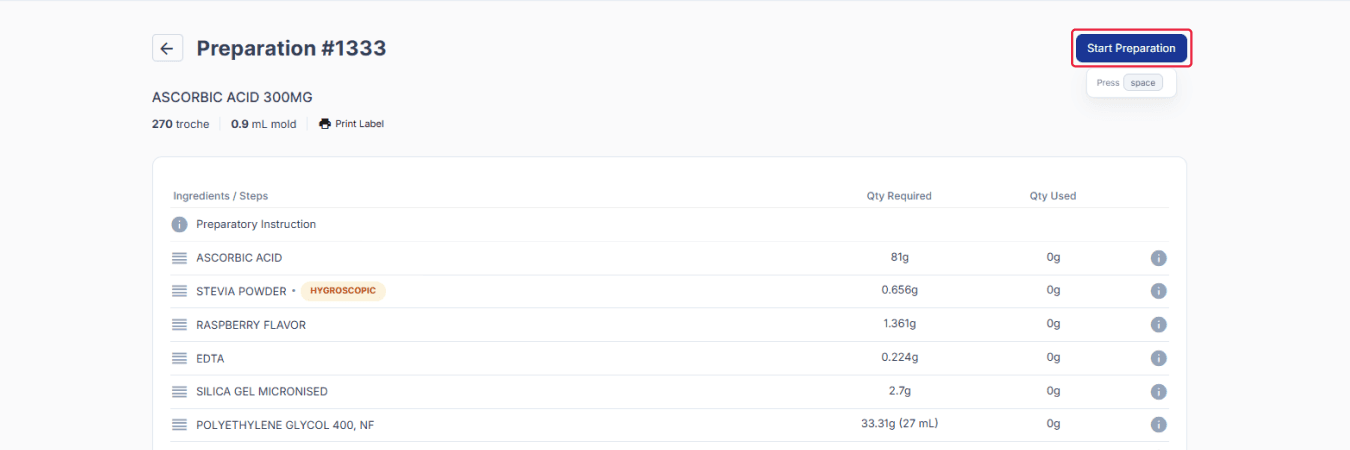
From the preparation page
After preparation is complete, click ‘✔ Sign Off’ to confirm that the batch manufacture record has been checked and finalised.
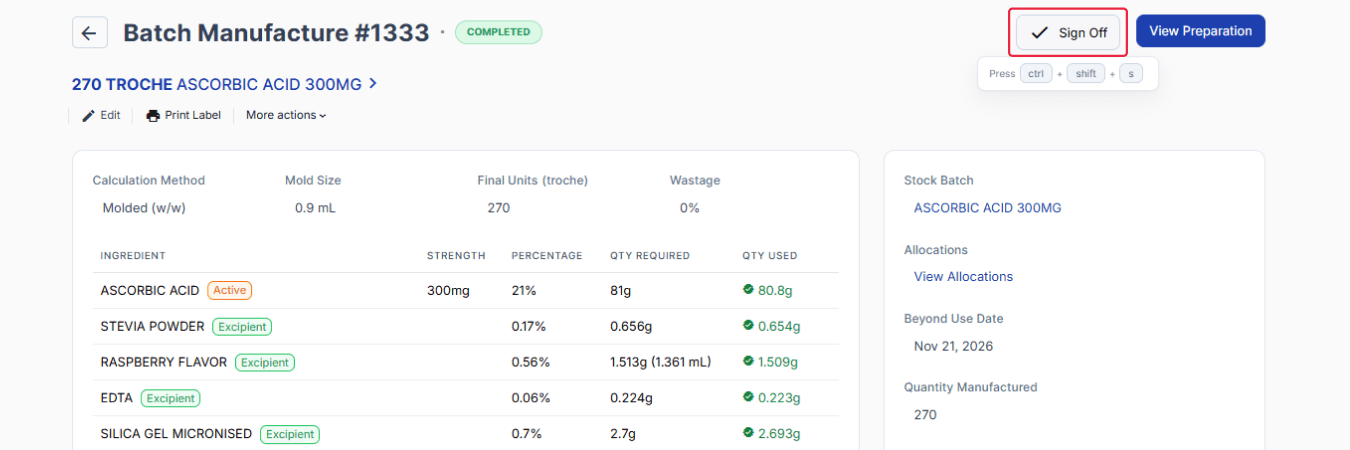
From the batch manufacture page
Then click ‘Approve & Open Batch’ to enable allocation to scripts.
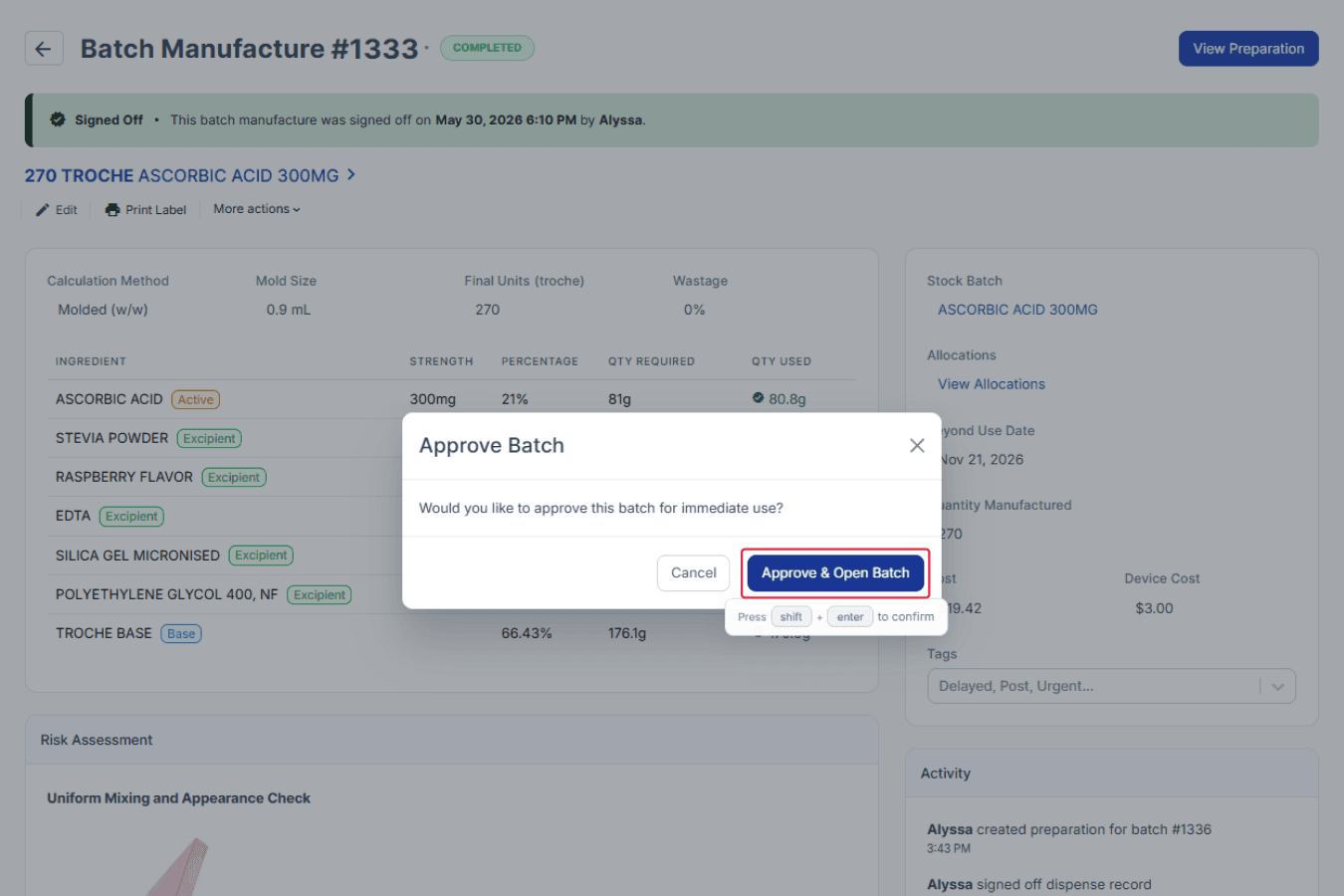
From the batch manufacture page
Step 4: Finalise the allocated scripts
On the Edit Stock Batch page, click ‘View Allocations’.
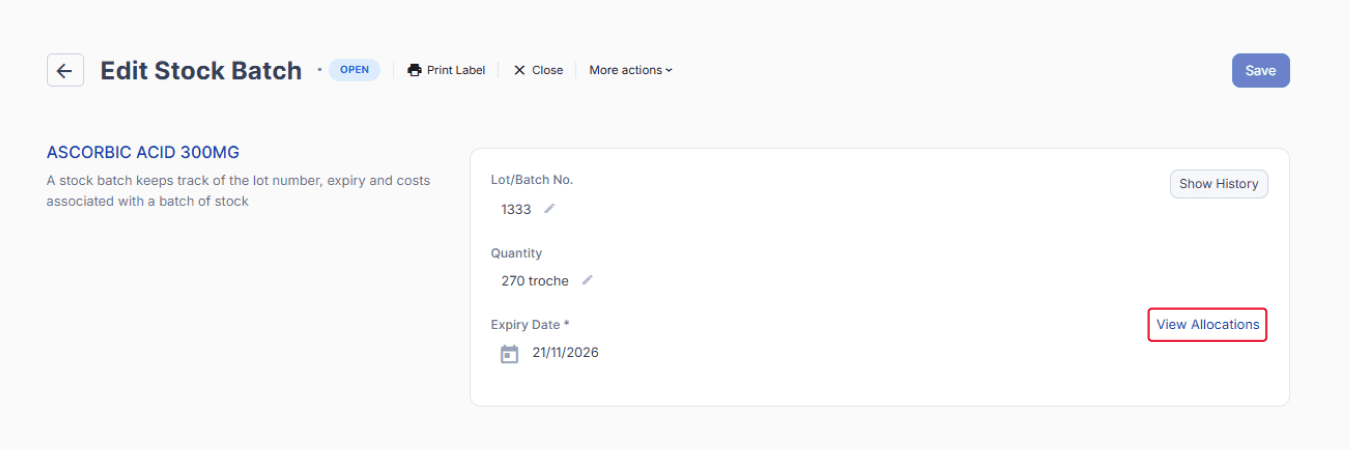
From the edit stock batch page
You may proceed to confirm the allocation of scripts by signing off individual dispense records.
On the Stock Batch page, click ‘Dispensed Record ID’ to open one of the pre-allocated scripts.
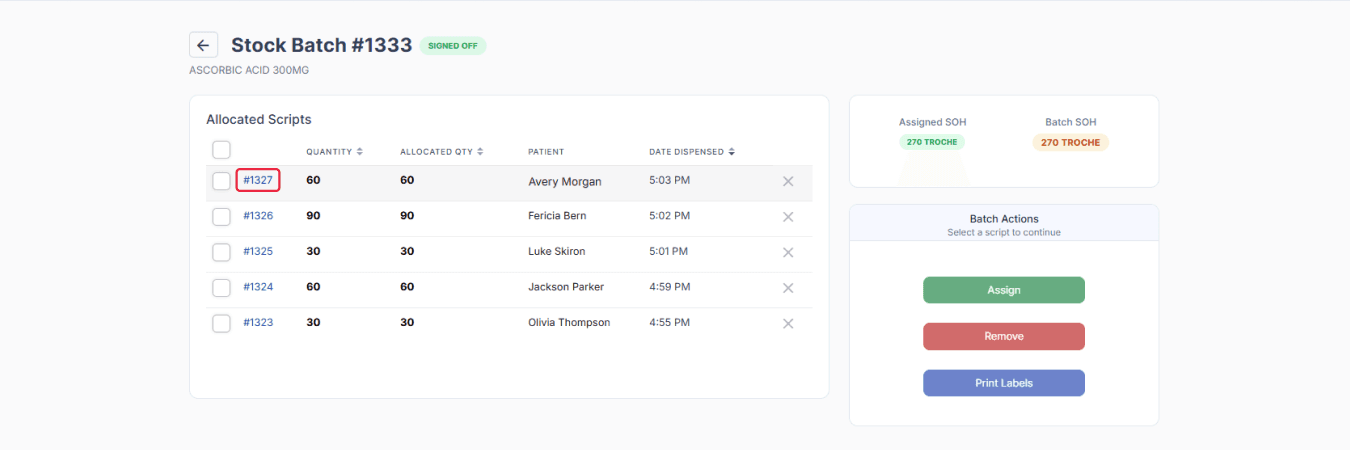
From the stock batch page
Important note: Signing off the dispense record is the final confirmation step in the allocation process. It is important to carefully review all details before signing off, as this action confirms that the allocation is complete and accurate. Once the dispensed record has been signed off, the batch cannot be unassigned.
On the Dispensed Record page, the lot/batch no. and quantity are already confirmed, allocated, and ready for final checking.
Once checked, click ‘✔ Sign Off’ to finalise the dispensed record.
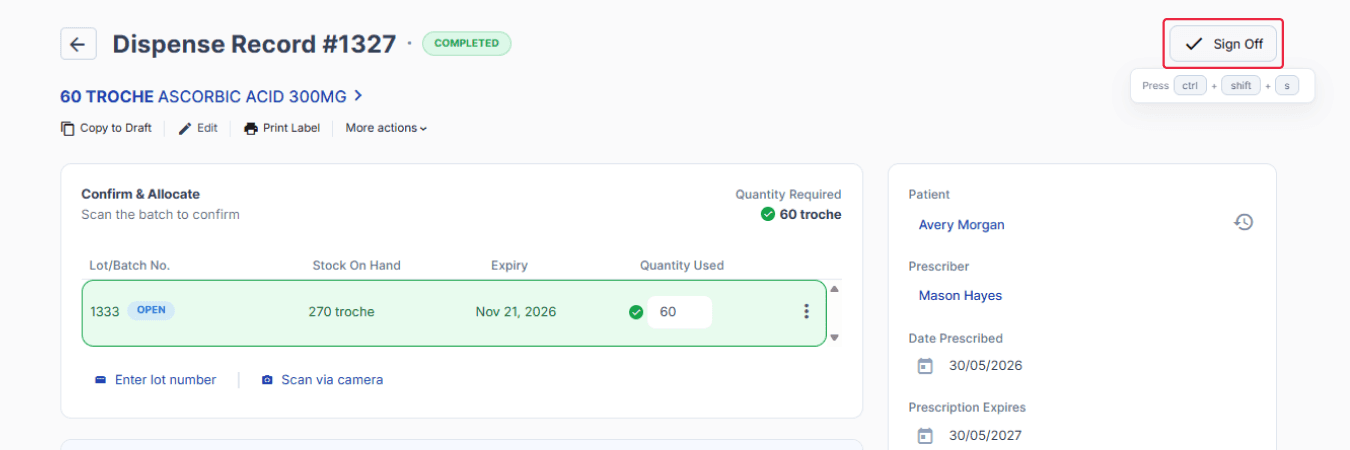
From the dispensed record page
Click the back arrow to return to the Stock Batch page and repeat the same process for the remaining pre-allocated scripts.
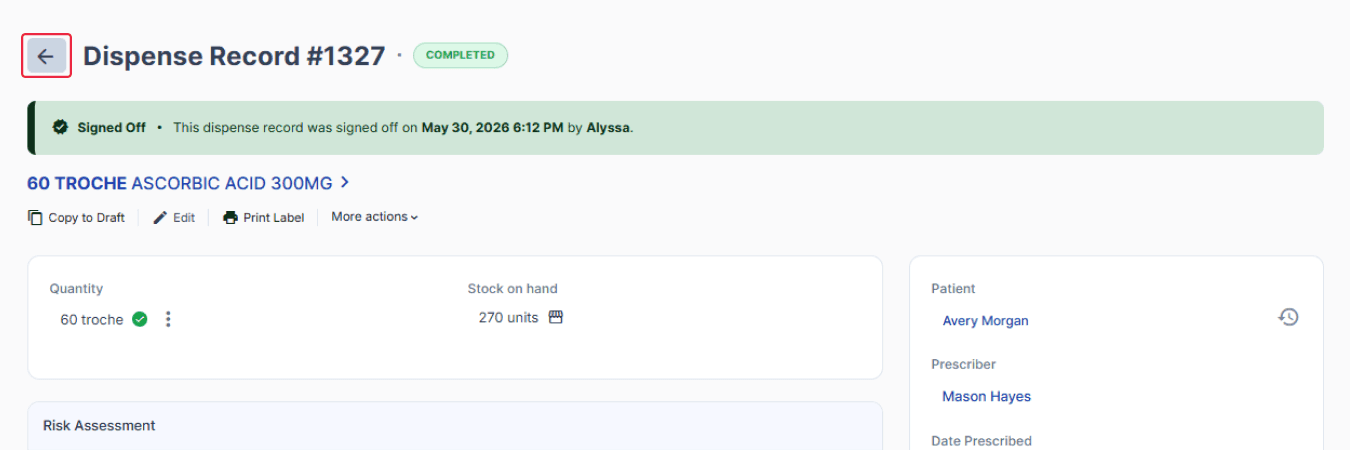
From the dispensed record page
Once all allocated scripts have been signed off on the Stock Batch page, they will move from Allocated Scripts to Signed Off.
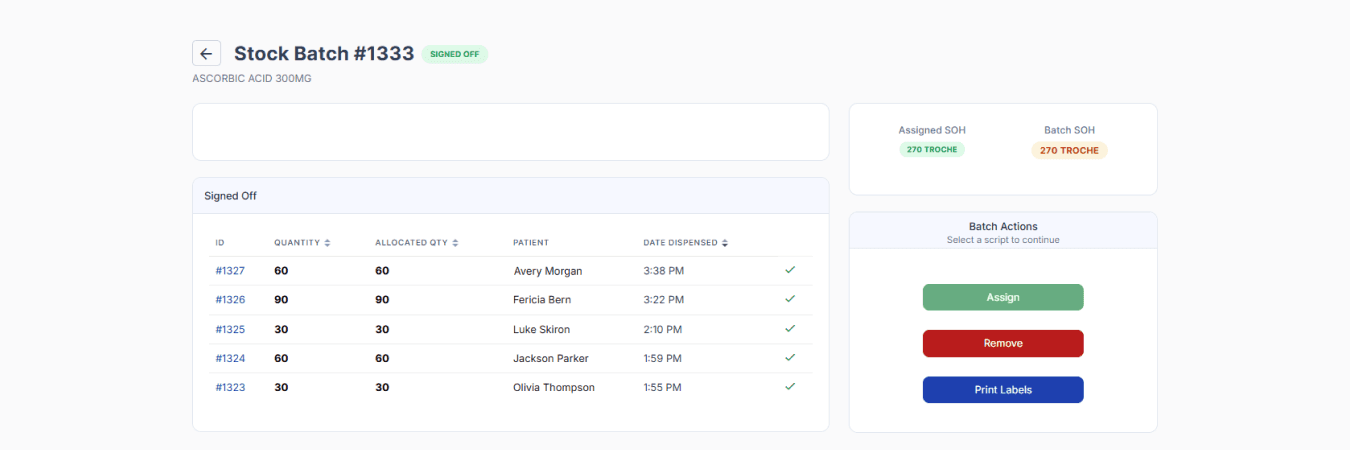
From the stock batch page
Pre-allocating scripts helps your pharmacy save time during dispensing while maintaining a stronger audit trail between the prescription, patient, and compounded batch. By allocating earlier in the workflow, your pharmacy can improve traceability, create time-stamped links that support regulatory and quality assurance defensibility, and reduce risks associated with retrospective allocation, such as incorrect batch assignment or missing audit history.
In the event of an audit, investigation, or recall, your pharmacy can more clearly demonstrate which batch was allocated, when the allocation occurred, and when the batch was compounded and signed off.
Conclusion
Compound Direct’s Automatic Bulk Allocation helps pharmacies manage internal batch stock more efficiently while supporting clearer traceability and audit readiness.
By allowing scripts to be pre-allocated before preparation is complete, your pharmacy can prepare labels earlier, reduce repetitive manual work, and maintain stronger links between scripts, patients, and batch manufacture records.
For pharmacies managing high-volume internal compounding, this workflow provides a more controlled and scalable way to manage multiple scripts from one batch.
FAQs
Does automatic allocation mean the batch is already approved?
No. Automatic allocation allows scripts to be tentatively pre-allocated automatically before preparation is complete. The batch still needs to be compounded, signed off, and approved before final dispensing.
Can I remove a script after it has been automatically allocated?
Yes. You can remove a pre-allocated script while it is still eligible for removal by selecting the script and clicking ‘Remove’ or the X button.
Can I print labels before the batch is signed off?
Yes. With automatic allocation enabled, scripts behave as though a batch has already been allocated for label printing purposes.
What happens after the batch is signed off?
After the batch is signed off and approved, the pre-allocated scripts are ready for final review and sign-off from the ‘Dispensed Record’ page.
Does automatic allocation improve traceability?
Yes. Automatic allocation creates earlier links between the script, patient, and batch manufacture record, which supports clearer traceability and audit readiness.
Can I assign more scripts after all stock on hand has been allocated?
No. Once all stock on hand has been allocated, the batch cannot be assigned to additional scripts.
All names and medical data shown in software screenshots are fictional and for demonstration purposes only. These figures represent fictional persons; any resemblance to real individuals is purely coincidental. Use of existing fictional names is for illustrative purposes and does not imply affiliation or endorsement.